Why your mobile glass service was faster than the shop
The Myth of the Brick-and-Mortar Superiority
For decades, the prevailing logic in the fenestration industry suggested that if you wanted a precision glass repair or a high-quality installation, you had to haul your vehicle or your window sash to a fixed shop. People assumed that the heavy machinery and the controlled environment of a warehouse were the only ways to ensure a proper glazing bead set or a durable chip repair. As a glazier with over 25 years in the field, I am here to tell you that this logic is as outdated as single-pane 1/8 inch float glass. The reality of modern mobile service is not just about convenience; it is about the physics of efficiency and the elimination of logistical dead-time.
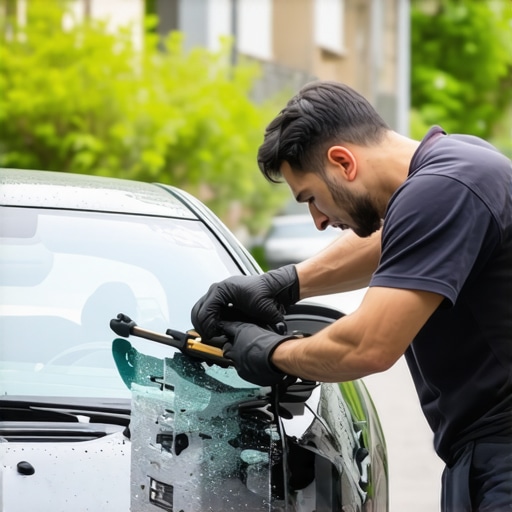
I recall a specific instance that illustrates this perfectly. A property manager in a high-traffic urban center called me in a panic on a Friday afternoon. A landscaping crew had kicked up a stone, shattering a tempered glass sidelite at the main entrance. She had already called three local glass shops. One told her they could get a crew out by Tuesday; another asked her to measure the rough opening herself and bring the frame to them. I arrived in my mobile rig within ninety minutes. I did not just have a piece of glass; I had a mobile fabrication station. While the shops were busy managing their intake queues and bay schedules, I was already cleaning the weep holes and prepping the sill pan. I had that unit replaced and the site secured before the sun went down. This was not magic; it was the result of a specialized mobile ecosystem designed for a surgical strike.
The Technical Mechanics of Mobile Chip Repair
When we talk about chip repair, we are talking about fluid dynamics and chemical bonding. A stone chip in a windshield or a glass pane is not just a cosmetic flaw; it is a structural failure. In a shop environment, your vehicle sits in a lot, then moves to a bay, then waits for a technician. In a mobile service scenario, the environment is managed on-site with immediate precision. The process involves injecting a clear, curable resin into the outer layer of the glass. This resin must have a refractive index nearly identical to the glass itself to ensure the repair is invisible.
The science of the same-day repair relies on managing the dew point. If there is moisture trapped inside that chip, the resin will not bond. A master glass installer working from a mobile unit uses vacuum-pressure tools to evacuate the air and moisture from the break before the resin is introduced. We use capillary action to ensure the resin reaches the furthest microscopic fissures of the ‘star break’ or ‘bullseye.’ We then use high-intensity UV lamps to trigger an anaerobic curing process. This happens in minutes, not hours. Because the mobile unit is a dedicated toolset, there is no cross-contamination or tool-sharing like you find in a cluttered shop. Every tool is exactly where it needs to be for that specific task.
“Installation is just as critical as the window performance itself. A high-performance window installed poorly will fail.” – AAMA Installation Masters Guide
Thermal Dynamics and Climate Logic
In northern, colder climates, the enemy of glass is heat loss and the dreaded condensation. When I perform a mobile installation in these regions, I am hyper-focused on the U-Factor. This is the rate at which a window, door, or skylight conducts non-solar heat flow. The lower the U-Factor, the better the unit is at insulating. During a mobile installation, we ensure that the replacement glass uses warm-edge spacers. These spacers are made of low-conductivity materials that keep the edges of the sash warmer, significantly reducing the chance of condensation forming at the perimeter of the glass.
We also utilize Low-E (low-emissivity) coatings on Surface #3. This is the side of the glass facing the interior of the building. By placing the coating here, we reflect long-wave infrared radiation (heat) back into the room during the winter. A mobile technician must be precise with the flashing tape and shim placement to ensure that the rough opening is completely sealed against air infiltration. If you leave even a 1/16 inch gap, you have essentially created a straw that will suck cold air into the building, rendering even the most expensive triple-pane glass useless.
The Logistics of the Same-Day Promise
Why is a glass installer in a van faster? It comes down to the ‘Shingle Principle’ of logistics. In a shop, every job is a multi-step process involving different departments. In mobile service, the technician is the estimator, the fabricator, and the installer. This eliminates the ‘hand-off’ errors that plague larger operations. When I pull up to a job, I am looking at the muntins, the operable hardware, and the glazing beads all at once. I am not waiting for a work order to be processed by a front-desk clerk.
Furthermore, mobile rigs are equipped with specialized glass handling equipment like vacuum suction cups and mobile racks that prevent the micro-fractures often caused by the constant loading and unloading in a shop environment. We manage the glass once. It goes from the rack to the opening. Minimal handling means minimal risk of ‘latent damage’ that might not show up until the first major temperature swing of the season.
“The National Fenestration Rating Council (NFRC) provides consistent ratings on window, door, and skylight energy performance, but these ratings are only valid if the thermal envelope is maintained during field installation.” – NFRC Field Manual
The Physics of the Installation Autopsy
Many homeowners call us after a shop-based installer has failed them. We call this the ‘Installation Autopsy.’ We often find that the previous installer relied on the nailing fin of the window rather than a proper sill pan and flashing tape system. Water management is a science. Gravity always wins. If the window is not integrated into the building’s water-resistive barrier using the ‘shingle lap’ method, it will leak. Mobile specialists are trained to diagnose these failures on the fly. We don’t just ‘caulk-and-walk.’ We look at the weep hole alignment to ensure that any water that enters the glazing pocket has a clear path to exit the building. If those holes are clogged or misaligned during a rushed shop fabrication, the sash will eventually rot or the insulated glass unit (IGU) will suffer a premature seal failure.
Choosing a mobile service means you are getting a dedicated environment focused solely on your specific glass needs. You are avoiding the overhead of a showroom and the delays of a centralized queue. Most importantly, you are getting a technician who understands that a window is a complex thermal bridge that requires technical precision, not just a bucket of silicone and a hammer. In the battle of the shop versus the van, the van wins on speed, precision, and the technical application of glazing science every single time.
{ “@context”: “https://schema.org”, “@type”: “HowTo”, “name”: “How to Perform an Emergency Mobile Glass Repair”, “description”: “Step-by-step guide on how professional mobile glass installers handle same-day chip repairs and replacements.”, “step”: [ { “@type”: “HowToStep”, “name”: “Inspection and Cleaning”, “text”: “The technician inspects the rough opening or chip for structural integrity and removes debris from weep holes.” }, { “@type”: “HowToStep”, “name”: “Moisture Evacuation”, “text”: “Using a vacuum tool, any moisture trapped in the glass fissures is removed to prepare for resin injection.” }, { “@type”: “HowToStep”, “name”: “Resin Injection and Curing”, “text”: “High-viscosity resin is injected and cured using UV light to restore the glass’s refractive index.” }, { “@type”: “HowToStep”, “name”: “Final Sealing”, “text”: “The glass is secured using professional glazing beads and flashing tape to ensure a thermal seal.” } ] }