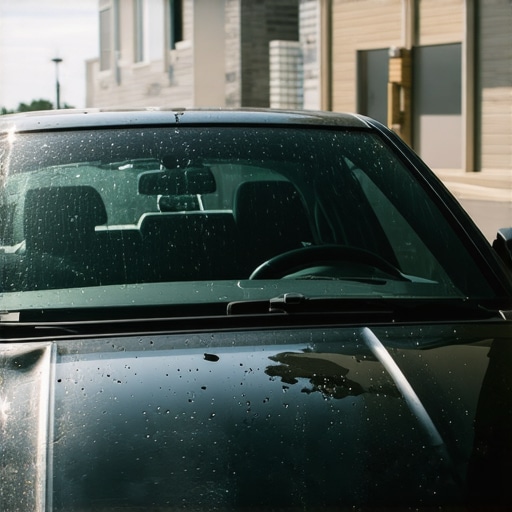
Why your windshield needs a day to sit before a car wash
The Invisible Bond: Why Patience is the Master Glazier’s Secret
In my twenty-five years as a glass installer, I have seen every shortcut in the book. I have watched ‘caulk-and-walk’ amateurs slap a piece of laminated safety glass into a pinchweld with the same care you would give a postage stamp. But the most dangerous mistakes do not always happen during the installation itself; they happen in the twenty-four hours that follow. A homeowner called me in a panic because their new windshield, installed by a mobile service only six hours prior, had developed a distinct ‘whistling’ sound at highway speeds. I walked out to their driveway with my ultrasonic leak detector and a hygrometer. I did not even need the tools to see the problem. The client had taken the car through a high-pressure touchless wash to ‘clean up the handprints’ from the installer. The 1200-PSI water jets had hit the fresh urethane bead while it was still in its plastic, non-cured state, creating a microscopic void in the seal. It was not a failure of the glass; it was a failure of the timeline.
The Chemistry of the Cure: Urethane vs. Water
When a mobile service glass installer performs a chip repair or a full replacement, they are relying on structural polyurethane. This is not a simple adhesive; it is a moisture-cured elastomer. In a Northern climate like Chicago or Minneapolis, the cold air often lacks the ambient humidity required to trigger the chemical cross-linking of the urethane. When we talk about a ‘same-day’ drive-away time, we are talking about the minimum threshold required for the glass to remain in place during a low-speed collision. We are not talking about the structural maturity of the bond. The ‘Safe Drive Away Time’ (SDAT) is a specific metric determined by FMVSS (Federal Motor Vehicle Safety Standards) 212 and 216, which ensure the windshield acts as a backstop for the passenger-side airbag and prevents a roof crush during a rollover.
“The adhesive bond must reach a specific Shore A hardness before the vehicle is returned to service. Failure to allow the chemical reaction to complete can result in a loss of structural integrity.” – AGSC (Auto Glass Safety Council) Standard 002-11
When you take that fresh installation into a car wash, you are introducing two enemies: high-pressure mechanical force and chemical surfactants. Most modern car washes use recycled water with a pH level that can be slightly acidic or basic depending on the detergents used. If these chemicals penetrate the ‘skin’ of the curing bead, they can arrest the polymerization process. The urethane needs to pull moisture from the air to harden from the outside in. By drenching it in soapy water, you are essentially suffocating the chemical reaction.
The Physics of the Pinchweld and the Bead
Every professional installation begins at the pinchweld. This is the ‘Rough Opening’ of your vehicle. If the previous installer left old urethane or, worse, scratched the paint down to the bare metal without applying a primer, you are looking at a future rust bucket. A master glazier ensures that the Pinchweld is clean, primed, and ready for a consistent V-bead of urethane. This bead must have the correct height and width to ensure that when the glass is ‘set,’ the adhesive spreads to the exact tolerances required. If you hit this bead with high-pressure water too early, you risk ‘shifting’ the bead. Even a shift of two millimeters can result in a leak. In the world of glazing, we follow the ‘Shingle Principle.’ Water must always have a path to flow down and away. When a seal is compromised by premature washing, the water no longer flows over the glass into the cowl; it finds its way into the interior A-pillar, eventually soaking the floorboards and triggering mold growth.
Thermal Stress and the Dew Point
In colder regions, the Dew Point becomes a critical factor for any mobile service. If the temperature of the glass is below the dew point of the surrounding air, a layer of condensation forms on the ceramic frit of the windshield. This invisible layer of water acts as a release agent. A technician who does not properly manage the thermal environment of the vehicle before applying the adhesive is setting the stage for a total bond failure. This is why many mobile services struggle in sub-zero temperatures. The ‘Same-Day’ promise often ignores the reality that at 20 degrees Fahrenheit, the chemical reaction of standard urethane slows to a crawl. If you add a car wash to this scenario, the cold water can cause the glass to contract rapidly, putting immense mechanical stress on a bond that has not yet reached its elastic modulus.
“Successful installation requires the management of environmental variables including temperature, humidity, and substrate cleanliness to ensure a permanent weather-tight seal.” – ASTM E2112 Standard Practice for Installation
The Anatomy of a Chip Repair
It is not just full replacements that need a ‘dry’ period. A chip repair involves injecting a clear, UV-cured resin into a break in the glass. While the UV light cures the resin in minutes, the structural bond is still settling. High-pressure water or the rapid temperature change from a car wash’s dryer can cause the repair to ‘bloom’ or spread. The resin expands and contracts at a different rate than the surrounding glass. Until that resin has fully integrated with the molecular structure of the glass, it remains vulnerable. I have seen countless repairs ‘pop’ back out because the owner wanted a clean car immediately after the technician left the driveway.
Why the ‘Tin Man’ Approach Fails in Glazing
I often see sales pitches for ‘instant-cure’ adhesives. While high-end, dual-component urethanes do exist, they are rarely used by high-volume, low-cost mobile services because they require specialized heating equipment and expensive applicator guns. Most ‘same-day’ installers are using a single-component moisture-cure product. This is where the ‘Tin Man’ logic—selling you the convenience without the science—gets dangerous. They want you to believe that because the car is drivable, it is ‘finished.’ But in my shop, ‘drivable’ and ‘cured’ are two very different things. A window is a hole in your car’s structural cage that must be managed for wind pressure, water ingress, and safety. If you ignore the 24-hour wait for a car wash, you are essentially telling the installer that you do not value the engineering that keeps your roof from collapsing in an accident. You wouldn’t paint a house and then immediately spray it with a fire hose; the same logic applies to the structural seal of your windshield.
The Checklist for a Successful Mobile Installation
When you hire a mobile service, you are inviting a technician to perform a surgical procedure in an uncontrolled environment. To ensure the best result, the vehicle should be parked in a shaded, wind-protected area. The technician should use a high-viscosity urethane that matches the OEM specifications of your vehicle. After the glass is set, they should use ‘retaining tape’ to prevent the glass from sliding—a process we call ‘setting’—while the initial skin forms. This tape should remain for at least 24 hours. The most important part of the process, however, is the advice the installer gives you before they leave. If they do not mention the car wash restriction, they are not a master glazier; they are a ‘caulk-and-walk’ artist. A real pro will explain the ‘Sash’ and ‘Muntin’ equivalents in your car—the moldings and the trim—and how they interact with the new seal. They will tell you to crack a window slightly when closing the doors to prevent the internal air pressure from ‘blowing out’ the fresh urethane bead. This level of technical precision is what separates a lifetime seal from a seasonal leak. Respect the chemistry, respect the cure, and give your glass the 24 hours it needs to become a permanent part of your vehicle’s safety system.