Why your mobile tech needs exactly one hour of dry weather
The Physics of the One Hour Rule
In the world of professional glass repair, time is not merely a measurement of duration but a critical variable in a chemical equation. When you book a mobile service for a chip repair, you are often told that the technician needs a window of dry weather. It is not because our equipment cannot get wet or because we are afraid of a few raindrops. It is because the structural integrity of your glass depends on the behavior of anaerobic resins at a molecular level. As a glazier with over 25 years in the field, I have seen too many ‘caulk-and-walk’ installers ruin a perfectly salvageable piece of glass by ignoring the hygrometer. We are dealing with tolerances measured in microns, and in that world, water is an invasive force.
A homeowner once called me in a panic because their recent repair on a large picture window was ‘sweating’ and turning milky. I walked in with my hygrometer and showed them that the internal humidity of the break was trapped. The previous installer hadn’t waited for the substrate to dry. They injected resin into a damp cavity. It was not the glass failing; it was a fundamental misunderstanding of moisture management. When water occupies the micro-fissures of a chip, the resin cannot displace it. Instead, you end up with a structural void that will inevitably fail when the temperature shifts and the dew point is reached inside the glass. [IMAGE_PLACEHOLDER]
The Anatomy of a Glass Fracture
To understand why dry weather is non-negotiable, we must look at the rough opening of the break itself. When an object impacts glass, it creates a series of radiating fractures known as legs. These are not just surface scratches. They are deep channels that reach into the laminate or the core of the pane. These channels act as capillaries. Through capillary action, even a small amount of atmospheric moisture is pulled deep into the fracture. If a glass installer attempts a same-day repair while it is drizzling, they are effectively trying to glue a wet sponge. The resin, designed to be hydrophobic, will bead up or fail to bond with the silica surface of the glass.
“Installation is just as critical as the window performance itself. A high-performance window installed poorly will fail.” AAMA Installation Masters Guide
This principle applies equally to a small chip repair as it does to a full-scale curtain wall installation. If the surface prep is compromised by H2O, the refractive index of the repair will be off. You will see a scar where there should be clear glass. But more importantly, the bond strength is reduced by as much as 70 percent. In a climate where we see rapid temperature swings, that weakened bond will give way. The resin and the glass have different expansion coefficients. Without a perfect chemical bond, the first frost or the first day of 90-degree heat will cause that chip to bloom into a full-length crack.
The Mobile Service Challenge
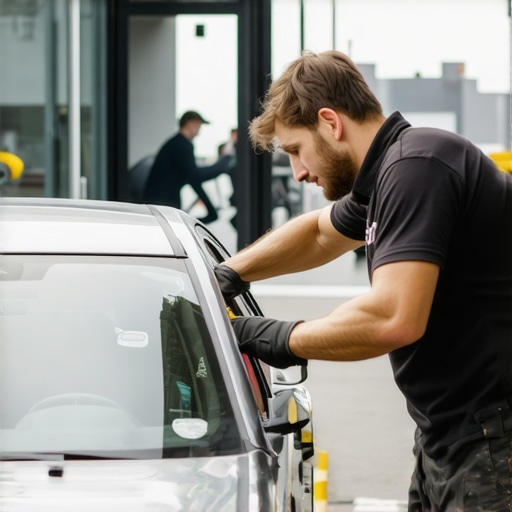
Mobile service technicians face an uphill battle against the elements. Unlike a controlled shop environment, the ‘field’ is unpredictable. This is why we insist on that one hour of dry weather before and during the process. We need the glass temperature to stabilize and any residual moisture to evaporate from the impact point. We often use heat guns or moisture evaporators, but these are supplements, not replacements, for a dry environment. The curing window is the final stage where UV light triggers the polymerization of the resin. If water is present, it interferes with the UV rays’ ability to penetrate the resin evenly, leading to a ‘soft’ cure.
I have spent decades dealing with glazing beads, shims, and sill pans in architectural glass, and the physics never change. Whether I am leveling a massive storefront or filling a bullseye chip, the substrate must be pristine. A professional glass installer knows that ‘same-day’ is a promise of efficiency, but it cannot be a compromise on physics. If we rush the job, we are not just providing a service; we are creating a future liability. We use flashing tape and sill pans in windows to keep water out of the house. In glass repair, we use the dry hour to keep water out of the chemistry.
“Standard Practice for Installation of Exterior Windows, Doors and Skylights requires meticulous attention to moisture barriers and surface conditions to ensure long-term sealant adhesion.” ASTM E2112
Chemical Bonding and Refractive Index
The resin we use is a high-tech polymer designed to match the refractive index of the glass. This means that when the repair is finished, light passes through the glass and the resin at the same speed, making the repair invisible. However, water has a different refractive index. If even a microscopic layer of moisture is trapped between the glass wall and the resin, it creates a reflection. This is the ‘ghost’ or ‘silver’ look you see in poor repairs. It is the signature of a technician who didn’t wait for the glass to dry. Beyond aesthetics, the moisture prevents the resin from ‘wetting’ the surface. In glazing terms, we want the resin to become one with the glass. Water acts as a release agent, ensuring the two never truly become a single structural unit.
The Technician’s Toolkit
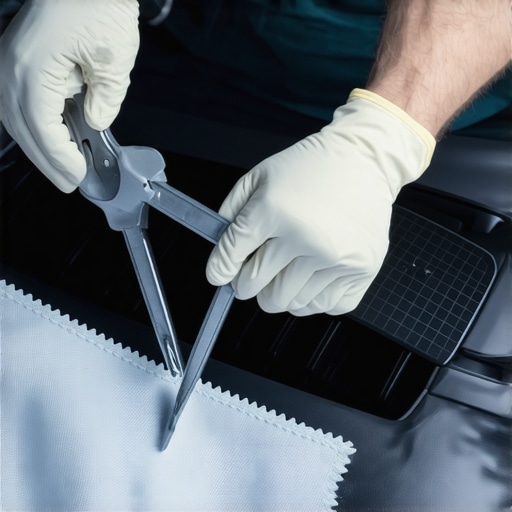
A master glazier doesn’t just show up with a bottle of glue. We arrive with a vacuum pump, a bridge, and a precision injector. The process begins by cleaning the muntin area if applicable, or more commonly, clearing the impact point of micro-shards. We then apply a vacuum to the break. This is where the dry weather is most critical. If the air is humid, the vacuum pump can actually pull moisture out of the air and into the break, or worse, create condensation due to the pressure drop. By ensuring a dry hour, we ensure that the vacuum is pulling out air, not water vapor. Once the vacuum is held, we inject the resin under pressure, forcing it into every microscopic leg of the fracture. This is followed by a curing period under a specific UV wavelength.
Climate Logic: Why Humidity Matters
In northern, colder climates, the enemy is the freeze-thaw cycle. If water is trapped in a repair, it will expand when it freezes, shattering the resin bond from the inside out. In these regions, the U-factor of the glass is critical, and a failed repair ruins the thermal performance of the unit. In southern, hotter climates, the concern is the SHGC (Solar Heat Gain Coefficient). The sun’s radiant heat can cook a repair. If there is moisture trapped, it can turn to steam, creating internal pressure that ‘pops’ the repair. No matter your location, the physics of glass remain constant. It is a brittle, non-crystalline solid that demands respect.
Conclusion: Don’t Settle for a ‘Quick’ Fix
When you are looking for a glass installer, do not just look for the fastest person. Look for the one who checks the weather report. A same-day service is fantastic, but a same-hour-as-a-rainstorm service is a red flag. The structural integrity of your windows or your windshield is what stands between you and the elements. A proper repair requires a dry substrate, a precise vacuum, and a full UV cure. That sixty-minute window of dry weather is the difference between a permanent solution and a temporary patch that will fail when you need it most. Trust the experience of someone who has seen what happens when you ignore the science. Wait for the dry hour. Your glass will thank you.