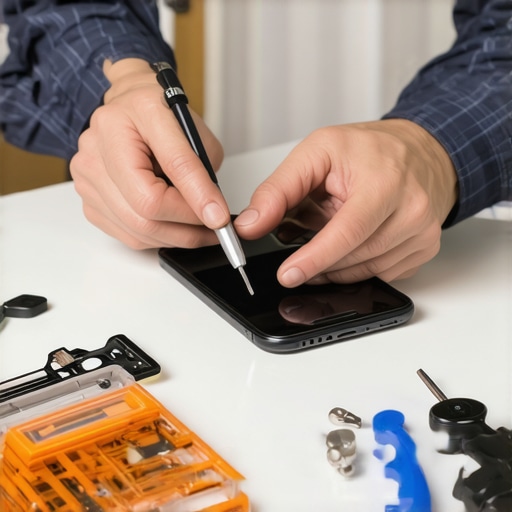
Why your mobile repair tech needs a flat surface
The Physics of the Mobile Glass Repair Environment
When you call for a same-day mobile glass service, the convenience of having a glass installer come to your driveway or office parking lot is undeniable. However, as a master glazier with a quarter-century in the trade, I can tell you that the environment where that repair occurs is not just a backdrop; it is a critical component of the chemical and mechanical bond. The demand for a flat surface is not a tech being picky; it is an absolute requirement of the physics of glass restoration. A chip repair is not a simple patch job; it is a surgical intervention into the structural integrity of the glazing unit.
The Slope Failure: A Cautionary Tale
A homeowner called me in a panic because their recent chip repair had failed within forty-eight hours, the small bullseye fracture spidering across the entire laminate. I walked out to their property and immediately saw the culprit. I walked in with my digital level and showed them the driveway was at a seven-degree pitch. The mobile tech who performed the work had attempted to use a vacuum-seal bridge on a slope. Because the center of gravity of the injector assembly was shifted, the pressure was uneven across the glazing bead. It wasn’t the resin that failed; it was the lack of a level workspace that prevented the resin from reaching the furthest reaches of the microscopic star-breaks. It was their parking situation, not the product, that caused the failure.
“Installation and repair conditions are just as critical as the window performance itself. A high-performance repair executed in an unstable environment will fail to meet structural requirements.” – AAMA Installation Masters Guide
The Mechanics of the Bridge and Injector
To understand why a flat surface is mandatory, one must understand the tool used by a professional glass installer. The bridge is a precision instrument that attaches to the glass surface via suction. It holds an injector directly over the impact point. This injector must be perfectly perpendicular to the glass to create an airtight seal. When the tech begins the pressure-vacuum cycles, they are forcing a low-viscosity, UV-curable resin into the rough opening of the chip. If the vehicle or the glass pane is at an angle, gravity pulls the resin toward the lower side of the fracture before it can be fully pressurized. This creates air pockets. In my years of experience, I have seen these air pockets expand when the dew point shifts, leading to total glass failure. A mobile service tech requires that level surface to ensure that the capillary action of the resin is uniform in all directions.
Thermal Dynamics and the North/Cold Context
In colder climates, the flat surface becomes even more vital due to the thermal stresses on the glass. When we deal with chip repair in the north, the U-Factor of the glass and the temperature of the substrate are everything. If the car is on an incline, the internal stresses of the glass are unevenly distributed. Glass is an amorphous solid; it reacts to torque. A car parked on a slope experiences subtle twisting in the chassis, which transfers to the window frames and the glass itself. When a tech applies a heat torch or a cooling element to stabilize the rough opening for repair, the uneven stress from the slope can cause the glass to crack instantly. We call this a ‘run-out.’ Using a flat surface ensures that the glass is in its most neutral, unstressed state before we begin the same-day repair process.
The Chemistry of Resin Curing
The resins used by a professional glass installer are formulated to have a specific refractive index that matches the glass. This ensures the repair is nearly invisible. However, these resins are also highly sensitive to UV light and oxygen during the curing phase. If the surface is not flat, the leveling film used to block oxygen from the resin will not sit flush. This results in a ‘pitted’ repair that will eventually catch a windshield wiper or collect dirt, leading to a visible scar on the glass. Furthermore, if the tech is working on an operable window that is tilted, the glazing bead might not provide the necessary support to keep the glass from vibrating during the curing process. Vibration is the enemy of a structural bond.
“Proper surface preparation and leveling are non-negotiable for achieving a structural bond in fenestration components.” – ASTM E2112 Standard Practice
The Invisible Dangers of Vibration
A flat surface usually implies a stable surface. When a mobile service operates in a high-traffic area or on a soft, uneven shoulder, micro-vibrations travel through the ground into the vehicle. As a glazier, I have seen repairs ruined because a heavy truck passed by while the resin was in its ‘gel’ state. On a flat, solid concrete pad, the vehicle’s suspension can effectively dampen these movements. On an incline or uneven dirt, the suspension is loaded unevenly, and the glass becomes a tuning fork for every vibration in the vicinity. This disrupts the shim-like precision required for the injector to do its job. For a same-day service to be successful, the environment must be as controlled as a laboratory.
Refraction and Visual Clarity
The goal of a chip repair is to restore the structural integrity and the optical clarity of the glass. If the repair is performed on a slope, the resin may pool thicker on one side of the break than the other. Because the resin and the glass have slightly different expansion coefficients, this uneven thickness can cause a prism effect. You might not notice it on a cloudy day, but when the sun hits the glass at a low angle, that uneven repair will create a glare. A professional glass installer knows that a level work area is the only way to ensure that the resin cures in a uniform sheet, maintaining the original optics of the sash or windshield. This is why we insist on a flat surface: we are managing light and physics, not just filling a hole.
Conclusion: Quality Over Convenience
While the mobile service model is built on speed and convenience, the laws of physics do not take a day off. If you want a chip repair that lasts the life of the vehicle or the building, you must provide the technician with the tools they need to succeed, and the most important tool is a flat piece of ground. A same-day repair is a great value, but only if it is done right. Don’t let a ‘caulk-and-walk’ mentality ruin your glass. Ensure the area is level, the glass is shaded, and the tech has the stability they need to perform a master-level glass installer service. Water management, thermal stability, and structural integrity all begin with a level foundation.