Why your car’s safety sensors fail after a bad glass installation
The Precision Crisis: Why Your Windshield is No Longer Just Glass
I sat across from a high-pressure mobile glass technician who was trying to convince a customer that a same-day glass installer could handle a modern luxury SUV in a grocery store parking lot. I had to step in and explain to the vehicle owner why the ROI on that shortcut was a potential collision. The reality is that modern automotive glass is a complex optical component, not a simple piece of transparent shielding. When you opt for a mobile service that prioritizes speed over technical precision, you are essentially gambling with the brain of your vehicle. The Advanced Driver Assistance Systems, or ADAS, rely on the windshield to act as a perfect lens. If that lens is slightly tilted, distorted, or improperly bonded, the entire safety suite fails. This is the difference between a car that stops for a pedestrian and one that doesn’t see the threat until it is too late.
“Installation is just as critical as the window performance itself. A high-performance window installed poorly will fail.” AAMA Installation Masters Guide
To understand why safety sensors fail, we must first look at the physics of the Rough Opening. In the world of glazing, the frame that holds the glass must be perfectly prepared. When a technician rushes a chip repair or a full replacement, they often ignore the tolerances of the pinchweld. If the glass is not positioned with the exactness of a surgical instrument, the camera mounted behind it is looking through the wrong part of the glass. A shift of even two millimeters can translate to a thirty-foot error in the car’s perception of objects a hundred yards away. This is why the concept of the Shim is so important in architectural glass and why setting blocks are vital in automotive glass. If the glass sits too low in the frame, the camera’s pitch is altered. The car thinks the road is rising or falling when it is actually flat.
The Physics of Refraction and Optical Distortion
Every piece of glass has a refractive index. Standard soda-lime glass used in most windshields is designed to allow light to pass through with minimal bending. However, low-quality glass from a cut-rate glass installer often contains striations or cooling marks. These are invisible to the naked eye but catastrophic for a CMOS sensor. When the camera attempts to calculate the distance to the car ahead, it uses triangulation. If the glass has a wave in it, the light rays are bent before they reach the lens. This creates a ghosting effect in the data. Think of it like trying to read a book through a glass of water. The words are there, but they are shifted and blurred. For a computer trying to make millisecond decisions, this distortion is a fatal flaw. The glass must be a monolithic, optically pure barrier.
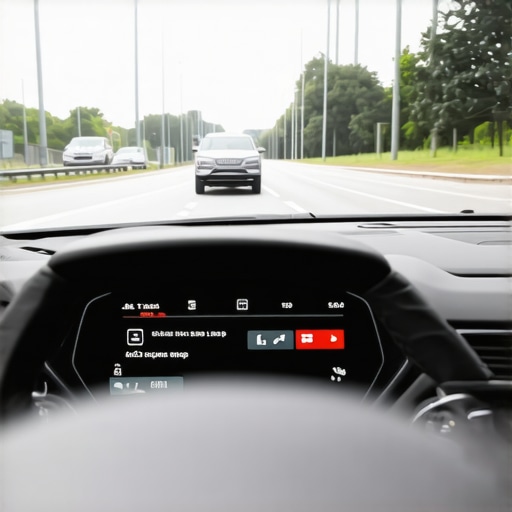
In southern climates where the sun is relentless, the Solar Heat Gain Coefficient (SHGC) becomes a critical factor for sensor health. High-quality glass utilizes a Low-E coating on Surface #2. This is the interior side of the outer pane in a laminated glass sandwich. This coating is designed to reflect long-wave infrared radiation back into the atmosphere. Without this protection, the black plastic housing that holds the ADAS camera becomes a literal oven. I have seen sensor housings reach temperatures exceeding 150 degrees Fahrenheit because a cheap replacement glass lacked the proper thermal management properties. When electronics get that hot, the solder joints expand, the processors throttle down, and the system eventually shuts off. You get a dashboard warning saying ‘Front Camera Unavailable,’ and suddenly your high-tech car is back in the 1990s.
The Structural Integrity of the Glazing Bead
The urethane used to bond the glass to the frame is not merely an adhesive. It is a structural component that contributes to the rigidity of the vehicle’s roof. In a rollover accident, the windshield provides up to 60 percent of the cabin’s structural strength. A same-day service often uses low-viscosity urethane that has a fast tack time but a slow full-cure time. If you drive the car before the Glazing Bead has fully cross-linked, the glass can shift. Even a microscopic movement during that first drive home can misalign the camera bracket. This is why I advocate for controlled environment installations. A shop floor is level; a driveway is not. If the car is sitting on an incline when the glass is set, the frame is under torsion. Once the car is moved to level ground, the glass is under stress, and the camera’s alignment is permanently compromised.
“A high-performance window installed poorly will fail. The integration of the glazing unit into the surrounding wall or frame is the primary defense against system failure.” ASTM E2112 Standard Practice
We must also discuss the role of the Muntin and the Sash in architectural terms as they relate to the vehicle’s structure. While a car does not have traditional muntins, the ceramic frit, that black dotted pattern around the edge of the glass, serves a similar purpose. It protects the urethane from UV degradation and provides a rough surface for the bond. A technician who doesn’t understand the chemistry of the primers will see the frit as purely decorative. If the primer is not applied correctly, the bond will fail, allowing moisture to seep in. This moisture eventually reaches the sensor array. I have pulled back the headliner on cars where a bad installation allowed water to bypass the Weep Hole logic of the cowl, dripping directly into the sensitive electronics of the lane-departure system. The resulting corrosion is invisible until the system simply stops responding.
Why Mobile Service Often Fails the Calibration Test
Calibration is the process of teaching the car’s computer exactly where the camera is located relative to the chassis. There are two types: Static and Dynamic. Static calibration requires a perfectly level floor, specific lighting conditions, and a series of targets placed at precise distances. A mobile service cannot provide this. If they tell you they are doing a dynamic calibration, which involves driving the car, they are relying on the car to find its own landmarks. This is less precise and can be hampered by poor weather, faded road lines, or heavy traffic. If the glass is installed with a slight tilt, the dynamic calibration might finish, but the system will operate at a reduced capacity, often braking late or drifting within the lane.
The issue of chip repair is also misunderstood. A chip in the critical vision area, which is the space directly in front of the ADAS camera, cannot be repaired. The resin used in chip repair has a different refractive index than the glass itself. Even if the repair looks clear to you, the camera sees a prism. This prism scatters the light, especially at night when facing oncoming headlights. This scatter causes the auto-high beam system to fail or the collision warning to trigger for no reason. In these cases, a full replacement is the only safe path. You must treat the glass as an Operable part of the safety system, not just a static window. Just as you wouldn’t use Flashing Tape to fix a structural crack in a header, you shouldn’t use a simple resin kit to fix a sensor-critical glass failure.
Conclusion: The Installer is the Key
At the end of the day, you can buy the most expensive, OEM-branded glass in the world, but if the installer treats it like a simple piece of transparent material, the technology will fail. You need a specialist who understands the interplay between the Sill Pan of the vehicle frame and the chemical properties of the glass. You need someone who knows that the glass is the primary lens for the vehicle’s safety systems. Don’t be swayed by the convenience of a parking lot repair. Demand a controlled environment, demand a certified technician, and understand that your safety depends on the invisible science of a perfect installation.