Why your car’s lane-keep assist needs a recalibration after a rock hit
The Evolution of the Windshield: From Wind Deflector to Optical Lens
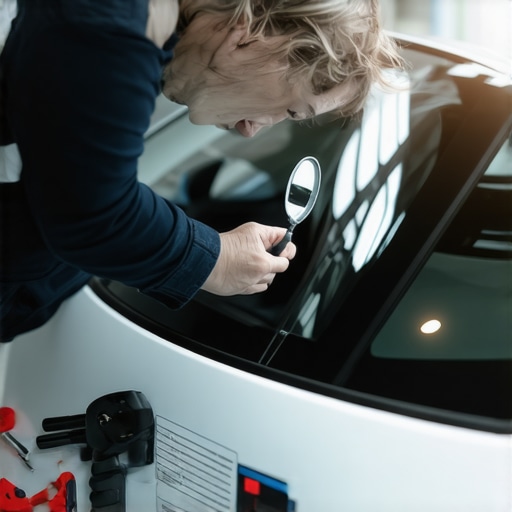
As a master glazier with over 25 years in the trade, I have seen the industry move from simple single-pane wood sashes to complex curtain walls. But perhaps the most radical shift has occurred in automotive glazing. A windshield is no longer just a piece of laminated glass designed to keep the bugs out of your teeth; it is a sophisticated optical lens and a structural component of the vehicle Safety Restraint System. When a rock hits that glass, it is not just a cosmetic flaw. It is a disruption in the field of view for your car’s Advanced Driver Assistance Systems (ADAS), specifically the lane-keep assist. If you think a simple chip repair from a random glass installer is the end of the story, you are risking the mechanical integrity of your vehicle’s safety net.
“Installation is just as critical as the window performance itself. A high-performance window installed poorly will fail.” AAMA Installation Masters Guide
I recall a specific instance where I sat across from a high-pressure salesman who was trying to convince a customer that a cheap, off-brand windshield replacement was the same as an OEM (Original Equipment Manufacturer) unit for their late-model SUV. He was pushing the speed of a same-day mobile service without mentioning a word about recalibration. I had to step in and explain to the homeowner that the ROI on a cheap windshield is negative the moment that lane-keep assist fails to see a lane marker and drifts the car into a ditch. The physics of light do not care about your schedule. If the glass has a different refractive index or even a slight variation in thickness, the camera behind the rearview mirror becomes legally blind.
The Physics of Refraction and the Camera’s Eye
When we talk about glazing in a technical sense, we must discuss the refractive index. Light travels at different speeds through different mediums. In a windshield, you have two layers of glass bonded by a PVB (Polyvinyl Butyral) interlayer. When a rock creates a chip, it introduces air and jagged edges into that laminate. This causes light to scatter, a phenomenon we call diffraction. If that chip is in the path of the ADAS camera, the camera’s software may misinterpret the distorted light as a road line, an obstacle, or nothing at all.
Even after a professional chip repair using high-quality resin, the optical properties are never 100% identical to the original glass. The resin has a specific density that might differ slightly from the glass. For a human eye, it looks clear. For a camera calibrated to detect micro-contrasts in lane markings at 70 miles per hour, it is a smudge on its glasses. This is why recalibration is not a luxury; it is a technical necessity. The camera needs to be taught how to ‘see’ through the new or repaired medium. This involves either a static recalibration, where the car is placed in front of specific targets in a controlled environment, or a dynamic recalibration, where the glass installer drives the vehicle at specific speeds to allow the sensors to find their bearings against real-world markers.
Thermal Stress and the Structural Role of Glazing
In high-heat climates like Phoenix or Texas, the glass is under immense thermal stress. The Solar Heat Gain Coefficient (SHGC) of your windshield matters because the ADAS camera is sensitive to heat. If you use sub-par glass that allows too much radiant heat to pass through Surface #2 (the inner side of the outer glass layer), the camera housing can overheat, leading to system failure. A master glazier knows that managing the dew point and thermal transfer is just as important in a car as it is in a skyscraper. When the sun beats down, the glass expands. If a chip has been repaired poorly, the difference in the expansion coefficient between the resin and the glass can cause the repair to fail, or worse, cause a crack to spider across the camera’s field of view instantly.
“The windshield is an integral part of the vehicle’s Safety Restraint System, providing structural support to the roof during a rollover.” Auto Glass Safety Council (AGSC)
When you call for a mobile service, you are looking for convenience, but you must ensure the glass installer is bringing more than just a tube of urethane and a suction cup. They need to understand the ‘Rough Opening’ of your vehicle’s frame. If the windshield is not set perfectly to the millimeter, the pitch and yaw of the camera will be off. A shim is not going to fix a poorly seated windshield in a modern car. The urethane bead must be consistent to ensure the glass sits at the exact height required by the factory specifications. If the glass is too high or too low, the camera’s angle of incidence changes, and your lane-keep assist will start ‘hunting’ for the lane, causing the steering wheel to jerk or vibrate unnecessarily.
The Critical Nature of the Urethane Bond
We often talk about the sash and the glazing bead in residential windows, but in automotive glass, the urethane is the hero. It is a high-modulus adhesive that turns the glass into a structural member. If a mobile service technician rushes the job and doesn’t allow for the proper cure time, the glass can shift. Even a shift of two millimeters can throw the ADAS calibration out of range. This is the ‘caulk-and-walk’ mentality that I despise. Precision is the only path to safety. When the rock hit occurs, the clock starts ticking. Dirt and moisture begin to fill the crater of the chip. If you wait too long, even the best chip repair will be optically compromised, making recalibration more difficult and less effective.
Understanding the NFRC Standards in Automotive Context
While the NFRC (National Fenestration Rating Council) primarily deals with buildings, the logic of their ratings applies here. We look at the U-Factor (heat loss) and the Visible Transmittance (VT). In a car, VT is paramount for the ADAS. Any installer who doesn’t prioritize the optical clarity of the camera’s viewing window is not a glazier; they are a tinkerer. The lane-keep assist relies on a clear, undistorted path of light. If the glass has ‘waves’ or ‘seeds’ (tiny bubbles) from a cheap manufacturing process, the camera will fail to calibrate. You must demand glass that meets or exceeds the original specifications of your vehicle to ensure the safety systems function as the engineers intended.
The Verdict on Same-Day Mobile Service
Is same-day mobile service possible? Yes. But it must be done with the right equipment. The technician must have the diagnostic tools to plug into your vehicle’s OBD-II port and initiate the recalibration sequence. They must ensure the vehicle is on a level surface and that the tires are properly inflated, as even a slight tilt of the car will affect the camera’s horizon line. Don’t buy the hype of a quick fix; buy the numbers and the technical expertise of a professional who treats your windshield with the same respect as a high-performance structural glazing unit.
[IMAGE_PLACEHOLDER]