The danger of glass shards in your fingers
When a homeowner looks at a cracked window, they see an inconvenience or a minor eyesore. When a professional glass installer with three decades in the trade looks at it, we see a pressurized plane of amorphous solid material waiting to release stored potential energy in the form of razor-sharp projectiles. The danger of glass shards in your fingers is not just a localized puncture wound; it is a complex surgical risk that arises when amateurs attempt to handle a failing glazing unit without the proper protective gear or technical understanding of glass tension. A mobile service exists for a reason: the risks of self-repair far outweigh the cost of a professional chip repair or full sash replacement.
The Anatomy of a Fracture: Why Glass Shards Migrate
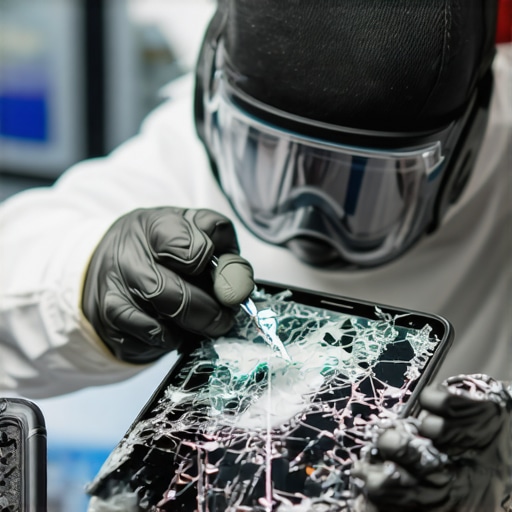
Glass does not break into predictable shapes unless it is tempered, and even then, the resulting fragments can cause significant harm. In standard annealed glass found in older homes, the conchoidal fracture patterns create edges that are literally sharper than a surgical scalpel. When you attempt a DIY fix, you are dealing with microscopic slivers known as spalls. These fragments are so small they can penetrate the dermis and migrate through the tissue toward nerves or tendons. I have seen homeowners who thought they had cleaned a site only to have a shard work its way into their palm weeks later, requiring an ultrasound-guided extraction. Professional glass handling involves specific vacuum-sealed tools and heavy-grade nitrile over-gloves to mitigate this exact risk.
“Installation is just as critical as the window performance itself. A high-performance window installed poorly will fail.” AAMA Installation Masters Guide
The Narrative Matrix: A Case of Interior Environment Failure
A homeowner called me in a panic because their new windows were ‘sweating.’ I walked in with my hygrometer and showed them the humidity was 60%. It wasn’t the windows; it was their lifestyle. They were running a humidifier in a sealed room during a Minnesota winter, creating a massive vapor pressure differential. The moisture was pooling at the glazing bead, and the homeowner had tried to ‘scrape’ the resulting mold away with a metal putty knife. One slip of that knife caused a localized pressure crack. In their attempt to wipe the glass, they drove a three-millimeter shard deep into their index finger. This is the reality of the trade: windows are the most volatile component of your building envelope, and they react violently to both environmental stress and improper maintenance.
Thermal Physics and the Northern Climate Challenge
In cold climates like Chicago or Minneapolis, the enemy is heat loss and the resulting condensation. We prioritize the U-Factor, which measures the rate of non-solar heat flow. A lower U-Factor means the window is better at keeping the heat inside. In these regions, we utilize triple-pane units with an Argon or Krypton gas fill to provide an insulating buffer. We specifically place the Low-E coating on Surface #3. This placement is strategic: it reflects the long-wave infrared radiation (your furnace’s heat) back into the room rather than allowing it to escape through the glass. When a chip occurs in this environment, the thermal stress between the cold exterior and the warm interior causes the crack to propagate almost instantly. This is why same-day chip repair is not a luxury; it is a structural necessity to prevent a total blowout of the insulated glass unit (IGU).
The Installation Autopsy: Why Mobile Service Matters
When we perform a mobile service for a broken pane, we aren’t just swapping glass. We are conducting an autopsy on why the glass failed. Was the rough opening out of square? Did the previous installer fail to use a proper sill pan? In many cases, we find that the window was shimmed too tightly, leaving no room for the natural expansion and contraction of the frame. This lack of a ‘thermal break’ puts the glass under permanent tension. When we arrive for a same-day repair, we check the weep hole functionality and ensure the flashing tape is still integrated with the weather-resistive barrier. If the sash is warped, a simple glass replacement won’t fix the underlying issue; the new pane will simply crack again under the same mechanical stress.
“The integrity of the fenestration system depends on the interface between the window frame and the rough opening. Without proper water management, the system is destined for latent defects.” ASTM E2112 Standard Practice
Technical Specifications: More Than Just a Clear View
A professional glass installer understands the NFRC labels better than a salesman understands a commission check. We look at the Visible Transmittance (VT) to ensure you aren’t living in a cave, but we balance that against the Condensation Resistance (CR) rating. In northern zones, a high CR is vital. If the edge of the glass—where the warm-edge spacer resides—gets too cold, you get localized dew point reaching the surface. This leads to rot in the muntins and eventually compromises the glazing bead. When you hire a professional for same-day service, they aren’t just bringing a piece of glass; they are bringing a calibrated understanding of how that glass must interact with your home’s specific thermal envelope.