How to stop a windshield crack from reaching the edge
The Physics of the Fracture: Why Glass Behaves Like a Fluid
As a master glazier with a quarter-century under my belt, I have seen every type of failure imaginable, from the massive stress cracks in tempered storefronts to the insidious spreading of a star-break on a high-end windshield. To understand how to stop a windshield crack from reaching the edge, you must first understand that glass is not just a solid; it is a rigid material under constant internal tension. When a stone hits your glass, it creates a point of localized stress. This is not just a surface wound. It is a structural breach in the laminated sandwich of the glass and the PVB (Polyvinyl Butyral) interlayer.
The Condensation Crisis and Thermal Shock
I recall a homeowner, Sarah, who called me in a panic because her windshield had ‘sweated’ and then suddenly developed a foot-long runner overnight. I arrived with my hygrometer and a thermal scanner. I showed her that the relative humidity inside her car was over 65 percent from a damp floor mat. When she hit that frozen glass with the high-heat defroster, the moisture trapped in the micro-fractures of a tiny, forgotten chip expanded. It was not the window’s fault; it was a basic violation of thermal dynamics. That tiny chip acted as a fulcrum for the stress of the temperature differential, forcing the crack to seek the nearest edge where the tension is highest.
“The structural integrity of a laminated assembly is dependent on the bond between the interlayer and the glass plies. Any breach in the glass surface allows moisture and air to penetrate, leading to delamination and crack propagation.” – ASTM C1172 Standard Specification for Laminated Flat Glass
The Anatomy of a Windshield: More Than Just a Window
In the world of architectural glazing, we talk about the Rough Opening and the Glazing Bead. In your vehicle, the frame is the rough opening, and the urethane used to bond the glass is the glazing bead. This bond is incredibly stiff. Because the windshield is a structural component of the vehicle’s cage, it is under constant pressure from the chassis. This is why a chip repair is so urgent. If you do not address it with a same-day mobile service, the vibrations from the road and the thermal expansion of the glass will eventually win. The glass installer must be precise; a poorly applied urethane bead can create high-stress points that make the glass more prone to cracking from the edge inward.
Surface Tension and the Low-E Parallel
Just as we use Low-E coatings to reflect long-wave infrared radiation in residential windows, automotive glass uses specialized tints and PVB layers to manage heat. When a crack exists, the light and heat are no longer distributed evenly. The crack creates a shadow in the thermal profile of the glass. The hotter side expands, the cooler side remains static, and the crack grows. To stop this, you need a chip repair that uses a high-index resin. This resin must match the refractive index of the glass perfectly to not only hide the blemish but to restore the surface tension. I often tell my apprentices that we are not just ‘filling a hole’; we are performing molecular surgery on a sash that happens to move at sixty miles per hour.
Why the Edge is the Danger Zone
The edge of a windshield is where the glass is most vulnerable. This is due to the ‘frit’—that black ceramic border. The frit is designed to provide a surface for the urethane to bond to and to protect the adhesive from UV degradation. However, because it is black, it absorbs more heat than the clear part of the glass. This creates a permanent thermal gradient. If a crack gets within two inches of that frit, the temperature difference between the black border and the clear glass will almost certainly pull the crack all the way to the edge. This is why a mobile service is vital. You should not be driving a vehicle with a live crack; the torsional flex of the frame is like a giant pair of pliers trying to snap the glass at the sill.
“Installation is just as critical as the window performance itself. A high-performance glass unit installed without proper edge clearance or under excessive bite will fail prematurely under thermal loads.” – AAMA Installation Masters Guide
The Master Glazier’s Strategy for Stabilization
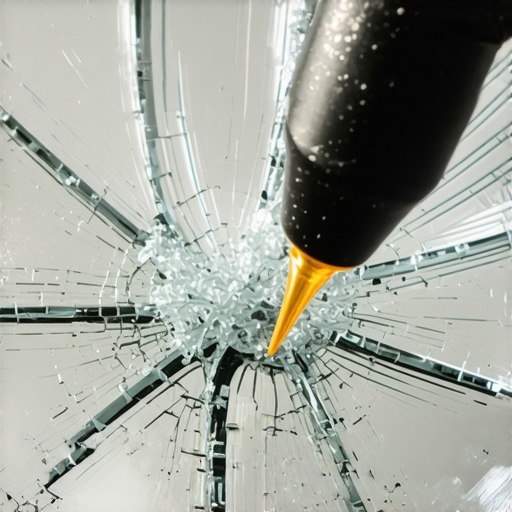
If you find yourself with a fresh chip, the first thing you must do is protect it from moisture. In the trade, we know that if a weep hole gets clogged in a window frame, the glass sits in water and the seal fails. Similarly, if water gets into a windshield chip, it carries dirt and oils that prevent the repair resin from bonding. Use a small piece of clear tape—not as a fix, but as a temporary shield. Then, call a glass installer for a chip repair immediately. We use a vacuum-pressure tool to suck the air out of the fracture and force the resin into the microscopic ‘legs’ of the crack. This is the only way to stop the movement. We are essentially installing a transparent shim inside the glass itself.
The Fallacy of DIY Kits
I have seen many ‘caulk-and-walk’ installers and DIY enthusiasts try to use store-bought kits. These kits lack the vacuum power to clear the air out of the break. If you leave air in the crack, you are leaving a compressible gas that will expand when it gets hot, blowing the crack wide open. A professional mobile service uses a bridge and injector system that can precisely control the pressure. We also use UV lamps to cure the resin instantly, ensuring that the operable structural strength of the glass is returned before you even put the car in gear.
Structural Integrity and the Long View
In high-rise glazing, we worry about wind load. In a car, your ‘wind load’ is constant. Every time you hit a pothole, the energy travels through the tires, up the suspension, and into the frame. The windshield is the last line of defense for the roof’s structural integrity in a rollover. A crack that reaches the edge compromises that entire system. You wouldn’t leave a muntin broken or a sill pan leaking in your home; don’t leave a breach in your vehicle’s primary safety shield. Address the chip today, or prepare to replace the entire unit tomorrow.