How to prevent your windshield from cracking further in a car wash
The sound of a windshield cracking during an automated car wash is a sickening pop that every driver fears. As a master glazier with over two decades of experience handling everything from tempered glass in high-rise curtain walls to the laminated safety glass in your vehicle, I can tell you that these failures are rarely the fault of the car wash itself. They are the result of neglected physics. A windshield is not merely a transparent barrier; it is a structural component of your vehicle, specifically a laminated assembly of two layers of glass sandwiching a polyvinyl butyral (PVB) interlayer. When you introduce a tiny chip into this pressurized system and then subject it to the thermal and mechanical stresses of a wash bay, you are essentially conducting a laboratory experiment in fracture mechanics.
I remember a specific case where a homeowner called me in a panic because their new windshield had shattered while they were sitting in a stationary car wash. I walked out to the vehicle with my hygrometer and a thermal imaging camera. I showed them that the interior humidity was hovering at 65 percent while the exterior glass temperature had plummeted forty degrees in seconds due to the cold rinse cycle. It wasn’t a defect in the glass installation; it was a pre-existing micro-fissure that had trapped moisture. The sudden thermal contraction of the outer lite while the inner lite remained warm caused the tension to exceed the glass’s modulus of rupture. It was a classic case of thermal shock acting on an unaddressed chip.
“Installation and maintenance are just as critical as the glass performance itself. A high-performance glazing unit installed poorly, or one that is compromised by structural damage, will fail under environmental stress.” – AAMA Installation Masters Guide
To understand why your windshield is at risk, we must look at the technical specifications of laminated glass. In a northern climate where winter temperatures frequently drop below freezing, the glass is under constant stress. When you have a small rock chip, you have a breach in the compression layer of the glass. This chip is often shaped like a bullseye or a star break. Within those tiny crevices, air and moisture are trapped. During a car wash, two things happen. First, the mechanical brushes exert physical pressure on the glass surface. Second, the high-pressure water jets act as hydraulic rams, forcing water into the chip. If that water is significantly hotter or colder than the glass, the material undergoes rapid expansion or contraction. This is where the Coefficient of Thermal Expansion (CTE) becomes your enemy. Glass does not handle rapid gradients well. The localized stress at the tip of the crack becomes a focal point for the energy to release, resulting in a long, unrepairable run.
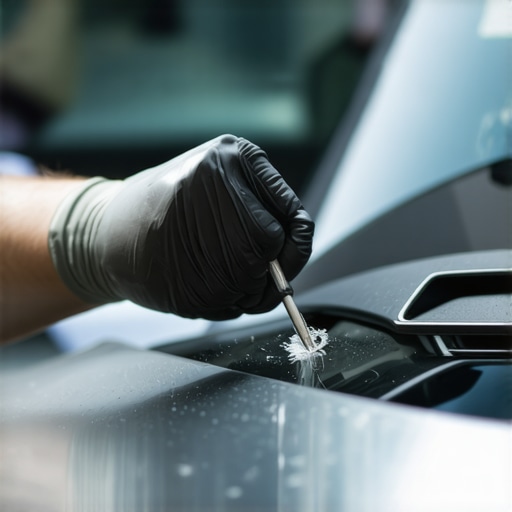
This is why a professional glass installer emphasizes the importance of a mobile service for chip repair. You cannot wait. A same-day repair is the only way to ensure the integrity of the PVB interlayer remains intact. When a technician performs a chip repair, they aren’t just filling a hole with glue. They are using a specialized injector to create a vacuum, removing the air and moisture from the fracture, and then injecting a clear, UV-curable resin with a refractive index nearly identical to the glass itself (approximately 1.52). This restores the structural tension and prevents the hydraulic pressure of a car wash from finding a weak point.
“The integrity of the laminated glass assembly is paramount for occupant safety. Any breach in the outer lite must be addressed according to ROLAGS standards to maintain the structural capacity of the glazing.” – ANSI/NWRA ROLAGS Standard
In the world of architectural glazing, we talk about the rough opening and the shim process to ensure a window is perfectly level and under no undue stress. Your car’s pinchweld is the rough opening for your windshield. The glass is held in place by a bead of high-modulus urethane. While this urethane allows for some flex, it cannot protect the glass from the internal pressures of a crack. If you see a chip, you should avoid the car wash entirely until a professional can examine it. Even the simple act of the drying blowers at the end of the tunnel can exert enough air pressure to turn a 5mm chip into a 50cm crack. The cost of a same-day chip repair is a fraction of the cost of a full windshield replacement, which requires pulling the molding, cleaning the pinchweld, and ensuring a perfect seal to prevent leaks.
For those in cold climates, the risk is doubled. If you have the defrost on high and then enter a car wash with cold water, the thermal gradient is extreme. We call this the dew point crisis in the architectural world, but in your car, it is a recipe for a fractured lite. Always ensure your glass is at a stable temperature before subjecting it to high-pressure water. If you already have a crack that has begun to run, a chip repair is no longer an option. At that point, the structural integrity of the sash (the frame holding the glass) is compromised, and the glass must be replaced by a certified glass installer. Don’t let a small impact point turn into a total loss. Seek out a mobile service that can handle the repair at your location, ensuring that the resin is cured in a controlled environment before you ever head back to the car wash bay.