Why your car’s heads-up display looks blurry through cheap glass
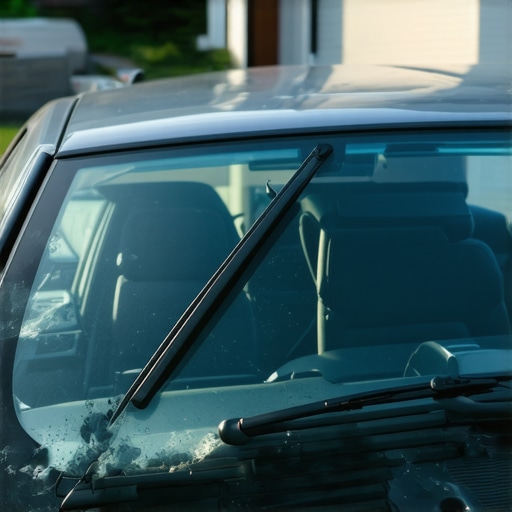
You spend sixty thousand dollars on a precision-engineered machine, a marvel of modern aerodynamics and digital integration, only to have the entire experience ruined by a piece of glass that costs less than the tires. As a master glazier with a quarter-century in the trade, I have seen it all, from the massive curtain walls of city skyscrapers to the delicate replacement of historic wood sashes. But lately, I am seeing a disturbing trend in the automotive sector that mirrors the ‘caulk-and-walk’ mentality I despise in residential window installation. You notice it the moment you pull out of the shop: your Heads-Up Display (HUD) looks like a blurred, ghostly mess. This is not a software glitch. It is a fundamental failure of glazing physics. [image placeholder]
The Ghost in the Glass: A Physics Lesson
To understand why your HUD looks blurry, you have to understand that glass is not just a transparent barrier. It is a refractive medium. When light from your dashboard projector hits the windshield, it encounters two primary surfaces: the inner surface (Surface #1) and the outer surface (Surface #2). In a standard, low-cost windshield, these two surfaces are parallel. When the light hits the inner surface, a portion of it reflects back to your eyes. The rest of the light travels through the glass, hits the outer surface, and reflects back. Because the surfaces are parallel but separated by the thickness of the laminate, these two reflections do not align. They arrive at your eyes at slightly different intervals and angles, creating a ‘ghost’ image. In the world of high-end glazing, we call this optical deviation.
I once had a client who was a retired engineer. He had just gone to a high-volume mobile service for a same-day replacement because he had a minor rock chip that turned into a crack. He was lured by the promise of a cheap glass installer who claimed that ‘all glass is the same.’ He sat in my shop, absolutely fuming because his luxury SUV now felt like he was looking through a funhouse mirror. I had to explain to him that his original windshield used a specialized PVB (Polyvinyl Butyral) interlayer. This is not the standard plastic film found in cheap glass. Quality HUD-compatible windshields use a ‘wedge-shaped’ interlayer. This wedge is thinner at the bottom and thicker at the top, calculated to a precision of milliradians. This tiny variance in thickness ensures that the reflections from the inner and outer surfaces converge into a single, crisp image. When he went with the budget option, he got a standard parallel laminate. He saved two hundred dollars on the glass but effectively broke a five-thousand-dollar technology package in his dashboard.
“Installation is just as critical as the window performance itself. A high-performance window installed poorly will fail.” – AAMA Installation Masters Guide
The Science of the Interlayer
We need to zoom into the molecular level of that interlayer to truly appreciate the difference. In a high-quality chip repair or full replacement scenario, the glass installer must account for the refractive index of the materials. Standard soda-lime glass has a refractive index of approximately 1.52. When light transitions from the air to the glass, it slows down and bends. If the PVB interlayer is not perfectly calibrated to the glass thickness and the curvature of the windshield, the light scattering becomes unbearable. Cheap glass often suffers from ‘seeds’ (tiny air bubbles) or ‘stones’ (unmelted raw materials) within the glass melt. While these might be invisible to the naked eye during a quick inspection, they distort the light path of your HUD. Furthermore, in the Southern climates where the sun is an absolute hammer, the Solar Heat Gain Coefficient (SHGC) of your glass becomes a critical comfort factor. A cheap windshield lacks the advanced metallic oxide coatings that reflect long-wave infrared radiation. This is the same principle we use when choosing a Low-E coating for a residential window. In hot climates, you want that coating on Surface #2 to bounce the heat back outside before it ever enters the cabin. Without it, your car becomes a greenhouse, and your dashboard electronics, including that expensive HUD projector, are subjected to thermal stress that can lead to premature failure.
Why Mobile Service Doesn’t Always Mean Quality
The rise of the mobile service model has been a double-edged sword. On one hand, the convenience of a same-day chip repair is great for a busy professional. On the other hand, it has birthed a generation of installers who treat a windshield like a sticker rather than a structural component of the vehicle. When we talk about a ‘Rough Opening’ in a house, we have tolerances to work with. In a car, the pinchweld is your rough opening, and the tolerances are non-existent. If the installer doesn’t prep the surface properly, or if they use a low-modulus urethane to save money, the glass won’t sit at the exact angle intended by the manufacturer. Even a fraction of a degree of tilt can throw the HUD alignment off. I have seen installers skip the primer, or worse, leave the old ‘Glazing Bead’ of urethane uneven, creating a wavy surface. This isn’t just about a leak; it is about the structural integrity and optical clarity of the viewing area. A windshield is a ‘Sash’ that is permanently bonded to the car. If it is not perfectly flat and perfectly angled, the physics of reflection will fail you every time.
“The optical quality of the glazing is paramount for the integration of digital display technologies.” – ASTM E2112 Reference on Optical Deviation
The Myth of the ‘Equal’ Aftermarket Glass
The ‘discount glass peddler’ will tell you that their glass meets all Department of Transportation (DOT) standards. What they don’t tell you is that DOT standards are the absolute floor, not the ceiling. They cover basic safety, like how the glass shatters, but they say very little about optical precision or HUD compatibility. When you opt for the cheapest glass installer, you are getting glass that was likely produced in a facility with wider tolerances for ‘roll wave’ distortion. This is a subtle waviness caused by the rollers in the annealing lehr. While you might not notice it looking straight ahead at the road, the HUD projector, which sits at an acute angle to the glass, will pick up every single microscopic deviation. This is why the image looks like it’s vibrating or has a ‘halo’ effect. It is the result of the light hitting different thicknesses of glass as it moves across the distorted surface. It is the same reason why a cheap window in a house makes the trees outside look like they are underwater when you walk past. In a home, it’s an eyesore; in a car, it’s a safety hazard that causes eye strain and headaches.
The Solution: Demand the Spec Sheet
If you are looking for a glass installer, you need to ask about the PVB interlayer. Do not just ask for the price. Ask if the glass is OEM (Original Equipment Manufacturer) or OEE (Original Equipment Equivalent) with a tapered wedge. If they don’t know what a tapered wedge is, get out of there. You want a service that understands the importance of the ‘Weep Hole’ equivalent in automotive glass, which is the proper management of moisture around the pinchweld to prevent rust. You want someone who understands that a same-day chip repair is a temporary fix for a localized fracture, but a HUD blur is a systemic failure of the glazing material itself. Don’t let a ‘Tin Man’ style salesman convince you that the expensive glass is just a brand name. The numbers do not lie. The U-Factor, the SHGC, and the Luminous Transmittance are all superior in high-performance glass. When you are driving at seventy miles per hour, your eyes should be focused on the road, not trying to decode a blurry digital display caused by sub-par materials and a rushed installation. Precision matters. Physics matters. And in the world of glazing, you truly get what you pay for.