Why some windshield chips look silver from the driver’s seat
Understanding the Optical Disruption in Laminated Glass
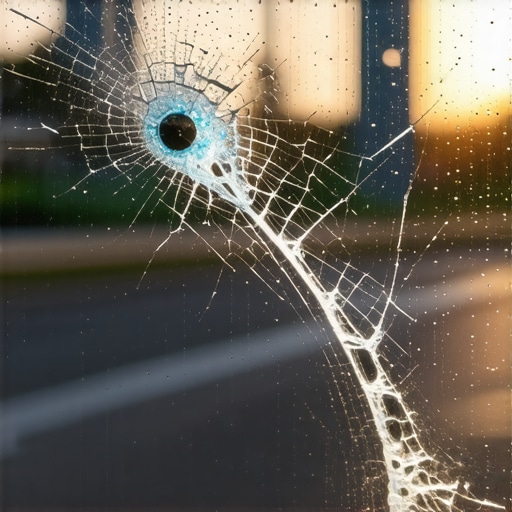
In the world of high-performance glazing, whether we are talking about the curtain wall of a skyscraper or the windshield of a modern sedan, we are dealing with a sophisticated assembly designed to manage light and structural integrity. When a stone strikes your windshield, it does not just create a mark; it initiates a complex physical transformation within the glass layers. As a master glazier with decades of experience, I have seen every type of fracture from wood sash impact to high-velocity stone chips. One of the most common questions I get from drivers is why a chip looks like a pocket of liquid mercury or a silver coin when viewed from the driver’s seat. The answer is not in the color of the glass, but in the physics of light refraction and the total internal reflection occurring within the laminate.
The Anatomy of the Silver Void
A windshield is not a single piece of glass; it is a ‘sandwich’ of two layers of annealed glass bonded together by a polyvinyl butyral (PVB) interlayer. This interlayer is what keeps the glass from shattering into dangerous shards upon impact. When a projectile hits the outer ply, it often creates a ‘bullseye’ or a ‘star break’ where a small pocket of the glass separates from the PVB layer. This creates a microscopic gap filled with air. This is where the ‘silver’ effect begins. Glass has a refractive index of approximately 1.51, while air has a refractive index of 1.0. When light passes through the glass and hits that air pocket at a specific angle, it cannot pass through. Instead, it reflects back entirely. This phenomenon, known as total internal reflection, turns that tiny air gap into a mirror. From your perspective in the driver’s seat, you are not seeing a ‘white’ or ‘clear’ hole; you are seeing the reflection of the surrounding environment within the glass itself.
“Installation and repair integrity are just as critical as the glass performance itself. A high-performance glazing unit, when compromised by a fracture, loses its structural load-bearing capacity and optical clarity.” – ASTM E2210 Standard Practice for Auto Glass
I recall a specific case involving a driver in a high-altitude climate. They walked in with what they thought was a ‘dirty spot’ that wouldn’t wash off. I used my inspection lamp and showed them that the ‘spot’ was actually a localized delamination. The silvering was so intense because the air inside the chip was under pressure. It wasn’t the glass that was silver; it was the light failing to navigate the air-to-glass boundary. This is why a mobile service technician uses a vacuum pump during a same-day chip repair. The goal is to evacuate that air—the ‘silver’—and replace it with a clear resin that has the exact same refractive index as the glass. If the resin is even a fraction off in its optical density, you will still see a ghostly outline of the repair.
Thermal Dynamics and the Danger of the Cold
If you are in a northern climate where the mercury regularly drops below freezing, that silver chip is a ticking time bomb. In these regions, heat loss and thermal shock are the primary enemies of glass. When you start your car on a January morning and blast the defroster, the interior ply of the windshield heats up and expands rapidly, while the exterior ply remains frozen. The air trapped inside that silver chip—the very air causing that reflection—also expands. Because the glass is already stressed at the impact point, the expansion force is often enough to ‘vent’ the chip, turning a small, repairable silver circle into a crack that spans the entire width of the dashboard. This is why a glass installer emphasizes immediate action. A same-day chip repair is not just about aesthetics; it is about preventing the inevitable structural failure caused by thermal expansion.
“The edge of any glass lite is its weakest point, and any internal fracture acts as a new edge, significantly reducing the pressure-loading capabilities of the entire assembly.” – NFRC Performance Guidelines
The science of the repair relies on the ‘wetting’ ability of the resin. When a professional glass installer applies the bridge and injector to the glass, they are not just squishing glue into a hole. They are using a specialized sequence of vacuum and pressure cycles to ensure the resin penetrates the deepest microscopic fissures of the break. As the resin fills the void, the silver disappears. This is because the light no longer sees an air-to-glass boundary; it sees a continuous medium with a consistent refractive index. The silver ‘mirror’ is replaced by a clear path for the light to travel. This is why the quality of the resin matters—cheap, low-viscosity resins may fill the hole but will eventually yellow or shrink, causing the silver reflection to return as the bond fails.
The Structural Role of the Glazing Bead and Adhesive
In a house, a window sits in a rough opening, held by shims and a glazing bead. In a vehicle, the windshield is a structural component of the roof’s strength. When that silver chip turns into a crack, the car’s structural integrity in a rollover accident is compromised. Using a mobile service for a same-day chip repair is the most efficient way to maintain this safety. A master technician will examine the ‘pit’ of the break. If the pit is contaminated with road salts or waxes, the resin won’t bond, and the repair will fail. We use a probe to clear the impact point, ensuring the resin can reach the PVB layer. This meticulous attention to detail is the difference between a ‘caulk-and-walk’ amateur job and a professional glazing repair that lasts the life of the vehicle.