The secret to stopping a windshield crack from spreading
The Anatomy of a Growing Fissure: A Master Glazier’s Perspective
I walked into a driveway in the dead of August after a homeowner called me in a panic because their new windshield was ‘sweating’ and then suddenly ‘snapped.’ I walked in with my hygrometer and an infrared thermometer. I showed them that the glass surface was sitting at 145 degrees Fahrenheit while their dashboard vents were pumping out 42-degree air. It wasn’t a manufacturing defect; it was a thermal stress fracture triggered by a neglected chip. This is the reality of glass. It is a supercooled liquid that behaves with rigid mathematical certainty. When you have a break in the surface tension of a laminated glass unit, you aren’t just looking at a cosmetic flaw; you are looking at a structural failure in progress. As a glass installer with over 25 years in the field, I have seen too many people wait until a small stone chip becomes a full-frame replacement. The secret to stopping a windshield crack from spreading isn’t a miracle glue from a hardware store; it is the immediate restoration of the glass’s structural integrity through anaerobic resin injection.
“Installation is just as critical as the window performance itself. A high-performance window installed poorly will fail, and in the case of automotive glass, failure is a safety compromise.” – AAMA Installation Masters Guide (Ref. Section 4.2)
The Physics of Laminated Glass and the PVB Interlayer
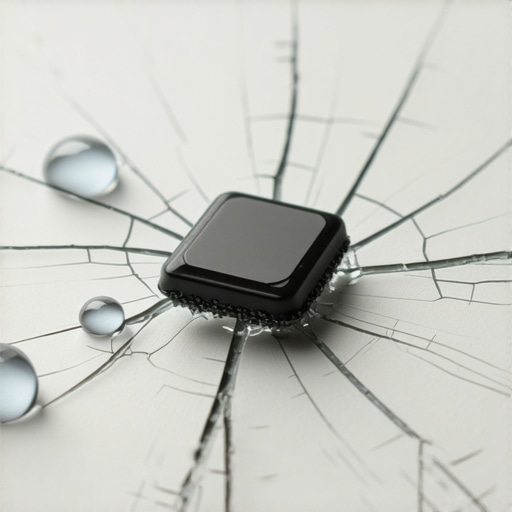
To understand why a crack spreads, you must understand what your windshield actually is. Unlike the tempered glass in your side windows, which shatters into tiny pebbles, your windshield is a sandwich. It consists of two layers of soda-lime glass bonded together by a Polyvinyl Butyral (PVB) interlayer. This interlayer is the hero of the story. It keeps the glass in one piece during an impact, but it is also the victim of every untreated chip. When a rock hits your glass, it creates a void. This void is a focal point for stress. In a mobile service context, we often see that the entry point of the stone has created a microscopic ‘Rough Opening’ in the glass surface. If water gets into that chip, it reaches the PVB. When that water freezes, it expands by 9%, acting as a hydraulic wedge that forces the glass layers apart. This is why same-day chip repair is not just a marketing slogan; it is a chemical necessity to seal the ‘Sill Pan’ of the break before contamination occurs.
Thermal Stress and the Surface Tension Equation
In the world of glazing, we talk about the ‘Dew Point’ and ‘Solar Heat Gain.’ For a windshield, the Solar Heat Gain Coefficient (SHGC) is high because the glass is designed to be clear, but it absorbs a massive amount of radiant energy. In a hot climate, the glass expands. If there is a chip, the expansion is uneven. The edges of the chip press against each other, creating a leverage point. This is where the ‘Glass Class’ comes in. We use resins that have a refractive index nearly identical to the glass itself. This isn’t just for aesthetics. By filling the void with a material that shares the same expansion and contraction rate as the glass, we neutralize the stress point. A professional glass installer uses a vacuum pump to remove every molecule of air from the break before injecting the resin under pressure. If you leave a tiny pocket of air, that air will expand when the sun hits it, and the crack will continue its journey across your field of vision.
“The primary goal of any glass repair is to restore the structural integrity of the laminate and prevent the spread of the damage by stabilizing the impact point.” – ROLAGS (Repair of Laminated Auto Glass Standard)
Why Mobile Service is the Gold Standard for Repair
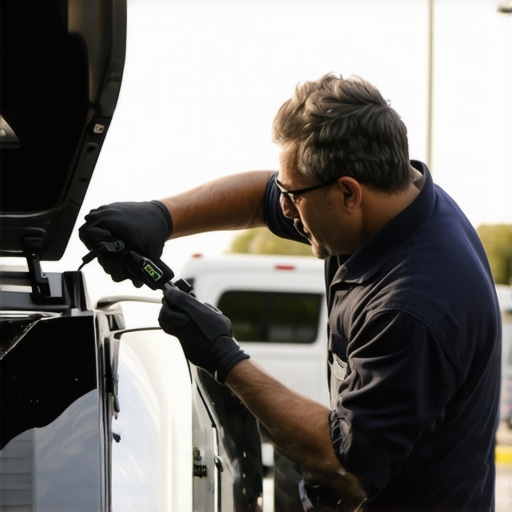
Many homeowners think they should drive to a shop, but the act of driving itself is a risk. Every time you hit a pothole, the chassis of your car flexes. That flex is transferred directly to the glass. If you have a chip, that flex acts like a ‘Shim’ being hammered into a gap. Our mobile service units are designed to stabilize the glass where it sits. We check the ‘Glazing Bead’ of the urethane seal to ensure there is no hidden stress from a poor original installation. We look for ‘Muntin’ alignment in the sense of the glass’s orientation to the cowl and the A-pillars. If the ‘Rough Opening’ of your car’s frame is slightly out of spec due to a previous accident, the glass is already under tension. Adding a chip to that equation is like pulling the pin on a grenade. We use high-viscosity resins in the summer and low-viscosity resins in the winter to account for the molecular density of the glass at different temperatures. This level of precision is why a DIY kit from a retail store will almost always fail; they don’t account for the glass’s current thermal state.
The ‘Shingle Principle’ of Water Management in Glass
In residential window installation, we use the shingle principle: everything must overlap so water flows down and away. In a windshield crack, the ‘Shingle Principle’ is violated. The crack creates a lip that catches water. Once water and road salt enter the ‘Sash’ or the cracked area of the glass, they begin to oxidize the PVB interlayer. This leads to delamination, which looks like a milky white fog around the edges of the crack. Once delamination begins, the glass is beyond repair. You are now looking at a full replacement. A mobile service technician will use a ‘Flashing Tape’ equivalent in the form of a pit-sealant to ensure that the final surface is flush and hydrophobic. This prevents the wiper blades from catching on the repair and prevents water from pooling in the microscopic ‘Weep Hole’ left by the impact.
The Math of ROI: Repair vs. Replacement
Let’s talk about the ROI. A chip repair is a fraction of the cost of a full windshield. But the real saving is in the factory seal. Your original windshield was installed by a robot in a controlled environment with a perfect ‘Glazing Bead’ of urethane. Once that seal is broken for a replacement, you are relying on a human to perfectly prime and bond the new glass to the ‘Rough Opening’ of the pinch-weld. If they miss a spot, you get wind noise or, worse, rust. By choosing same-day chip repair, you are preserving that factory seal and the structural integrity of your vehicle’s roof crush protection. Don’t listen to the ‘Tin Man’ salesmen who tell you that every chip needs a new windshield. If it’s smaller than a half-dollar and not in the driver’s direct line of sight, a technical glazier can save it. The science of glass is unforgiving, but when managed with the right resins and thermal logic, it is incredibly resilient.