The secret to getting a perfect seal on a tempered glass screen protector
The Glazier’s Perspective: Why Your Screen Protector Fails
As a master glazier with over 25 years in the field, I have spent my career managing the interface between glass and the built environment. Whether I am hanging a massive curtain wall on a skyscraper or performing a delicate chip repair on a high-performance storefront, the physics of glass remain the same. People often ask me why their DIY screen protector installations look like a bubbly mess. The answer isn’t in the plastic or the glass itself; it is in the total lack of respect for the glazing environment. To get a perfect seal, you have to stop thinking like a consumer and start thinking like a glass installer. Precision glass installation is not a hobby: it is a battle against surface energy, microscopic particulates, and atmospheric conditions. If you treat the surface of your mobile device with the same rigor I use to prep a rough opening for a premium fiberglass casement window, you will achieve a seal that is functionally invisible. This isn’t about luck; it is about the chemistry of adhesion and the mechanical properties of tempered materials.
“A high-performance window installed poorly will fail. Installation is just as critical as the window performance itself.” AAMA Installation Masters Guide
The Condensation Crisis: A Lesson in Surface Preparation
A homeowner called me in a panic because their new windows were sweating. I walked in with my hygrometer and showed them the humidity was 60%. It wasn’t the windows; it was their lifestyle. I see this same phenomenon with mobile service for glass. People try to apply a tempered glass screen protector in a dry, dusty room and wonder why they have localized delamination or bubbles. They blame the product, but the reality is they failed to account for the ambient environment. Just as I must manage the dew point when sealing an insulated glass unit (IGU), you must manage the static charge and particulate count of your workspace. In my professional mobile service kits, I carry specialized cleaners that go beyond simple alcohol wipes. We are looking for a surface that is chemically clean, meaning no oils, no skin cells, and no surfactants left behind by cheap detergents. If there is a single micron of skin oil on that glass, the silicone adhesive layer of the protector will never achieve 100% wetting. You need to create a clean room environment, often achieved by running a hot shower to drop the airborne dust, before you even think about peeling the backing off that glass.
The Molecular Science of Tempered Glass Seals
When we talk about a perfect seal, we are talking about total surface contact. Tempered glass used in screen protectors is created through a chemical or thermal process that induces a state of high compression on the surface. This makes the glass incredibly hard, often rated at 9H on the Mohs scale, but it also makes it rigid. Unlike film protectors, tempered glass cannot conform to irregularities. If your device has a micro-abrasion or a minor chip, you are looking at an air pocket. This is why a mobile service for chip repair is so vital for automotive glass; we use resins with a specific refractive index to fill those voids. For a screen protector, the secret is the silicone adhesive layer. This isn’t glue; it is a low-viscosity silicone that relies on van der Waals forces to bond to the screen. To optimize this, the glass installer must ensure the rough opening of the screen is perfectly centered. If the protector hangs over the edge of the glass even by a fraction of a millimeter, it will pick up air from the perimeter. In the industry, we call this the glazing bead area. If the bead is not seated, the entire system is compromised.
The Anatomy of the Seal: Shims, Alignment, and Pressure
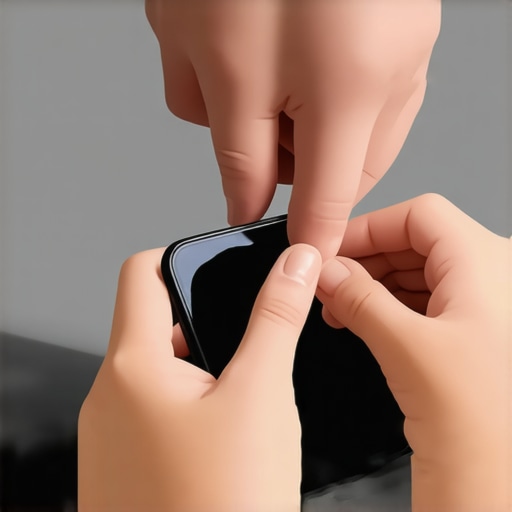
In window installation, we use a shim to ensure the sash is perfectly square within the rough opening. When applying a screen protector, your shims are your alignment tabs. Most people try to drop the glass on by hand, which is the quickest way to induce a skewed alignment. A professional glass installer knows that once the adhesive makes contact, the “wetting” process begins. This is a capillary action where the silicone spreads across the surface. If you have to lift the glass to reposition it, you have already lost. Each time you break that initial bond, you introduce the risk of attracting dust or creating a permanent stress mark in the adhesive. You need to use a hinge method, securing one side of the protector to the device with flashing tape to ensure it drops exactly into the correct position. This ensures the weep hole areas and sensors remain unobstructed and the seal is uniform from the center to the margins.
“Standard Practice for Installation of Exterior Windows, Doors and Skylights requires that the flashing system must be integrated with the water-resistive barrier to ensure long-term performance.” ASTM E2112
Environmental Factors: Temperature and Humidity
The success of same-day glass repair often hinges on the temperature of the substrate. If I am performing a mobile service for a windshield chip, I have to ensure the glass isn’t too hot or too cold, or the resin won’t flow. The same logic applies to your screen. If the device has been running hot, the silicone adhesive on the protector may cure or flow too quickly, leading to uneven thickness. Conversely, in a cold environment, the adhesive is more viscous and less likely to “wet” the surface properly. Aim for a stable 70 degrees Fahrenheit. This allows the adhesive to transition smoothly, pushing air ahead of the leading edge as it seals. You are essentially creating a laminated glass structure in real-time. If you see a bubble, do not press down on it immediately. Use a glazing tool or a soft squeegee to move the air toward the nearest edge. If you press the center of a bubble, you are simply trapping it and creating a vacuum that will eventually pull more air back in.
Why Mobile Service Professionals Outperform DIY
There is a reason people call a professional glass installer for same-day service instead of trying to patch a window themselves. It comes down to the tools and the experience of identifying failure points before they happen. A professional will inspect the glass for microscopic burrs at the edge. We understand the difference between an operable sash and a fixed lite, and we treat the touch-sensitivity of a mobile device with that same respect for mechanical function. The secret to that perfect, bubble-free seal is not a magic product; it is the combination of high-grade tempered glass, a chemically decontaminated surface, and a controlled installation technique that accounts for the physics of glass. When you stop seeing the screen protector as a sticker and start seeing it as a technical glazing project, you will finally get the results you are looking for.
[{“@context”:”https://schema.org”,”@type”:”HowTo”,”name”:”How to Get a Perfect Seal on Tempered Glass”,”step”:[{“@type”:”HowToStep”,”text”:”Create a dust-free environment using steam to settle airborne particulates.”},{“@type”:”HowToStep”,”text”:”Clean the substrate using a high-purity isopropyl alcohol and a microfiber cloth to remove all skin oils.”},{“@type”:”HowToStep”,”text”:”Align the protector using the hinge method with adhesive tape to ensure perfect centering.”},{“@type”:”HowToStep”,”text”:”Allow the silicone adhesive to wet the surface naturally from one side to the other, avoiding trapped air.”}]}]