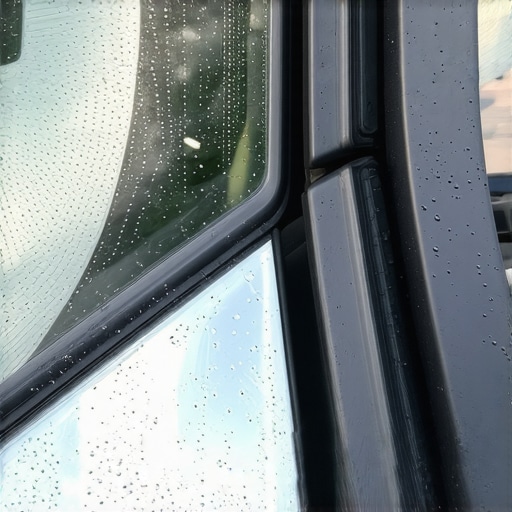
Why your side windows are harder to fix than glass
The Myth of the Quick Fix
As a Master Glazier with a quarter-century on the job, I have seen it all: from the 60-story curtain wall to the smallest basement casement. When a homeowner calls a mobile service expecting a same-day chip repair for their side window, they are often met with a harsh reality. You see, the term glass is a broad category, but the specific engineering behind side windows, particularly those in high-traffic or high-heat areas, makes them a binary system: they are either perfectly intact or they are a thousand tiny cubes on your floor. There is no middle ground for a resin injection here.
A homeowner called me in a panic because their new windows were ‘sweating.’ I walked in with my hygrometer and showed them the humidity was 60 percent. It was not the windows; it was their lifestyle, specifically their insistence on keeping a tropical plant nursery in a room with restricted airflow. This incident highlights a core truth in my trade: understanding the physics of the glass is only half the battle; the other half is understanding the environment in which that glass must survive. When we talk about side windows being harder to fix, we are talking about the fundamental difference between laminated and tempered safety glass.
The Physics of the Break: Tempered vs. Laminated
Most people associate chip repair with their car windshield. That is laminated glass: a sandwich of two layers of glass with a Polyvinyl Butyral (PVB) interlayer. When a rock hits it, the PVB holds the shards in place, allowing a glass installer to vacuum out the air and inject a clear resin. But your side windows, whether in your vehicle or the tempered side-lites next to your front door, are a different animal entirely. These are heat-treated to create intense internal tension. We heat the glass to over 1,100 degrees Fahrenheit and then quench it with high-pressure air. This process creates a compression layer on the surface and a tension core in the center.
“Installation is just as critical as the window performance itself. A high-performance window installed poorly will fail.” – AAMA Installation Masters Guide
When a side window is compromised by a chip or a deep scratch, that tension is released. The entire pane disintegrates instantly. This is why a mobile service cannot just fix a chip in a side window; they have to replace the entire unit. In hot climates like Texas or Arizona, the Solar Heat Gain Coefficient (SHGC) plays a massive role in this instability. If a window has a high SHGC and is trapped in a tight Rough Opening without proper Shims, the thermal expansion can cause the glass to press against a stray screw or a hard point in the frame, leading to a spontaneous shatter. This is not a failure of the glass, but a failure of the installation tolerances.
The Southern Climate Challenge: SHGC and Surface 2
In the South, the sun is the primary enemy. We are not just fighting the air temperature; we are fighting radiant energy. For side windows, we prioritize a low SHGC, which measures how much solar radiation passes through the glass. To achieve this, we use Low-E (low-emissivity) coatings specifically on Surface #2. For those not in the trade, Surface #1 is the exterior face, and Surface #2 is the inner face of the outermost pane in a double-glazed unit. By placing the coating here, we reflect the infrared heat back to the outside before it can even cross the air gap. If you use a same-day installer who does not understand the importance of coating orientation, you might end up with a window that technically fits but turns your room into an oven.
“The NFRC provides a reliable way to determine if a product will keep you comfortable and save you money.” – NFRC Performance Manual
Furthermore, we must discuss the Glazing Bead and the Weep Hole system. In high-heat zones, the Glazing Bead (the strip that holds the glass in the Sash) must allow for significant expansion. If the bead is too tight, the tempered glass has nowhere to go when it heats up. Similarly, if the Weep Hole is clogged with excess caulk from a ‘caulk-and-walk’ technician, water can sit in the Sill Pan, rot the sub-frame, and eventually create uneven pressure on the glass. A professional glass installer knows that a side window fix involves checking the entire drainage plane, not just swapping the glass.
The Anatomy of a Proper Replacement
When I perform a replacement, I am looking at the Rough Opening first. Is it square? Is there a Sill Pan installed to manage moisture? Most failures I see in the field are the result of poor water management. If water gets behind the Flashing Tape, it reaches the wood header or studs. I have seen 4×4 posts turned to mush because someone relied on a Nailing Fin and a prayer rather than proper mechanical flashing. When you call for a mobile service, ensure they are not just looking at the glass. They should be inspecting the Sash and the Muntin bars for structural integrity. If the frame is warped, your new tempered glass will be under constant stress from the moment it is snapped into place.
The complexity of side windows also stems from the hardware. Unlike a fixed picture window, side windows are often Operable. This means they have balances, hinges, and locks that must be perfectly aligned. If the window is out of plumb, the lock will pull the Sash unevenly, creating a localized stress point on the glass. Over time, or during a particularly hot afternoon, that stress point becomes the catalyst for a total break. This is why ‘harder to fix’ is an understatement; it is an entirely different engineering challenge that requires a holistic view of the building envelope.
{“@context”:”https://schema.org”,”@type”:”HowTo”,”name”:”How to Identify if Your Side Window Needs Replacement vs Repair”,”step”:[{“@type”:”HowToStep”,”text”:”Identify the glass type by looking for the permanent etch or bug in the corner. If it says ‘Tempered’ or ‘Tuf,’ it cannot be repaired for chips.”},{“@type”:”HowToStep”,”text”:”Check for surface scratches. If a fingernail catches in the scratch, the structural integrity of the tempered glass is compromised.”},{“@type”:”HowToStep”,”text”:”Examine the frame for signs of thermal stress, such as warped glazing beads or compressed shims.”},{“@type”:”HowToStep”,”text”:”Measure the squareness of the rough opening to ensure the new glass unit will not be under mechanical tension.”}]}