Why your mobile glass fix failed after a car wash
I walked onto a job site last Tuesday where a homeowner was staring in disbelief at their luxury sedan. A few hours earlier, they had a mobile service technician perform a same-day chip repair. It looked perfect when the tech drove away. Then the owner took it through a high-pressure car wash. By the time they reached the drying blowers, that tiny bullseye had blossomed into a twelve-inch crack reaching toward the passenger side A-pillar. I brought out my digital hygrometer and a magnifying loupe to perform a proper autopsy on the failure. I showed them that the humidity trapped inside the fracture during the mobile service was actually the culprit. It was not the car wash itself that failed, but the installer who ignored the basic laws of thermodynamics and moisture management. The previous installer relied on speed rather than proper evacuation of the break. This is the reality of the glass industry: physics does not care about your schedule.
The Molecular Failure of Same-Day Resin Bonding
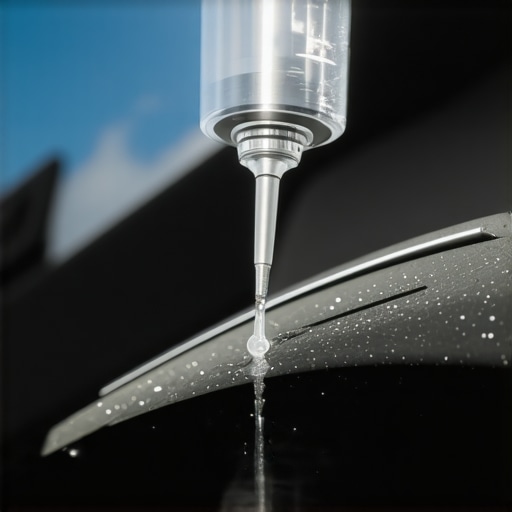
To understand why a mobile glass fix fails, you have to look at the glass through the eyes of a master glass installer. A windshield is not a single slab of material. It is a sandwich of two layers of annealed glass with a sheet of Polyvinyl Butyral (PVB) in the center. When a rock hits the outer layer, it creates a void. A chip repair is the process of injecting a clear, UV-curable acrylic resin into that void. However, if the mobile service tech does not use a high-vacuum pump to remove every microscopic pocket of air and moisture, you are essentially sealing a ticking time bomb. The resin used in cheap, same-day repairs often has a different refractive index and, more importantly, a different coefficient of thermal expansion than the surrounding glass. When you enter a car wash, you are subjecting the glass to extreme thermal shock. If it is a hot day and the car wash uses cold water, the glass contracts rapidly. If the resin has not achieved a full molecular bond with the internal surfaces of the break, the contraction pulls the glass away from the resin, and the pressure of the water forces its way into the microscopic gaps. This hydrostatic pressure acts like a wedge, splitting the glass along the lines of least resistance.
“Installation is just as critical as the window performance itself. A high-performance window installed poorly will fail.” AAMA Installation Masters Guide
The Shingle Principle and Moisture Entrapment
In architectural glazing, we talk about the Shingle Principle, the idea that every layer of a system must shed water to the exterior. When a chip repair is performed, the resin acts as the glazing bead, providing the seal that prevents water from reaching the PVB interlayer. In the case of the failed mobile repair, the tech failed to account for the dew point. If there is even a hint of moisture inside that chip when the resin is injected, that moisture is trapped. During a car wash, the high-pressure nozzles can reach 1,200 to 1,500 PSI. This force is directed right at the repair site. If the resin has not cured to a hardness that matches the glass, the water pressure will find the path of least resistance. Once a single molecule of water gets behind the resin, the bond is compromised. This is why a proper glass installer will use a dry-out tool to ensure the rough opening of the break is completely devoid of H2O before any resin touches the surface. Without this step, the repair is nothing more than a cosmetic mask that will fail the moment it is stressed.
Thermal Shock and the North-Cold Physics
In cold climates like Minneapolis or Chicago, the enemy is heat loss and the resulting contraction. When your car is sitting in the sun, the glass expands. The internal temperature can reach 140 degrees Fahrenheit. If you drive that hot glass into a car wash that uses 50-degree water, the U-Factor of the glass becomes irrelevant compared to the thermal stress. The outer layer of the glass wants to shrink, but the inner layer is still warm. This creates a shear force within the PVB interlayer. A professional chip repair must be able to withstand these forces. Most mobile service operations use a one-size-fits-all resin. A true specialist understands that the viscosity of the resin must be adjusted based on the ambient temperature. Thick resin in cold weather won’t penetrate the tiny legs of a star-break. Thin resin in hot weather may shrink too much during the UV curing process. When the car wash hits that improperly filled break, the structural integrity of the glass is already compromised. The sudden drop in temperature causes the glass to snap because the resin was not providing the necessary structural support to equalize the stress.
“Glazing systems must be designed to accommodate the movement of the glass and the frame without putting undue stress on the seals.” ASTM E2112 Standard Practice
The Fallacy of the Same-Day Mobile Service
The marketing for mobile glass repair often emphasizes speed. They tell you they can fix it in fifteen minutes at your office. As a glazier with 25 years in the trade, I can tell you that fifteen minutes is barely enough time to properly clean the glass, let alone evacuate a break. To do it right, you need to clear the break of debris using a carbide scribe, then set a bridge and injector. You have to cycle between vacuum and pressure modes multiple times. This isn’t just about filling a hole; it’s about rebuilding the structural integrity of the glazing unit. When you rush this, you leave air in the break. Air is compressible; glass is not. When the car wash blowers hit the windshield, they create a pressure differential. That tiny pocket of air inside the repair expands and contracts, eventually causing the resin to delaminate. You need an installer who treats the windshield like a structural component of the vehicle, not just a transparent shield. They need to check the weep hole of the cowl to ensure moisture isn’t backing up, and they must ensure the sash of the repair area is perfectly prepped.
What to Look for in a Professional Glass Installer
If you want to avoid a car wash disaster, you need to stop looking for the cheapest mobile service and start looking for a master of the craft. A real pro will measure the temperature of the glass before they start. They will use a UV shield to prevent the resin from curing prematurely while it is still flowing into the fracture. They will talk to you about the refractive index and the cure time. They won’t just slap a piece of curing tape over it and tell you it’s fine to drive. They will explain how the resin needs to reach a specific Shore D hardness to match the surrounding glass. When you look at the repair, it should be virtually invisible, not because the color matches, but because the air has been removed so thoroughly that light passes through the repair without bending. If your installer doesn’t talk about these technical details, they are just a parts-swapper, and your glass is likely to fail the next time it faces a garden hose or a car wash. Professional glazing is a science of managing the rough opening and ensuring that every shim and seal is placed with precision.