Why your screen protector won’t save a shattered corner
The Illusion of Safety: Why Glass Protectors Fail at the Edge
I have spent over two decades in the glazing industry, and if there is one thing I have learned, it is that glass is a material defined by its internal contradictions. It is a solid that behaves like a liquid, a transparent barrier that can withstand thousands of pounds of wind pressure but will disintegrate if a single pebble strikes a specific tension point. I often see people trying to ‘save’ a damaged glass panel with a screen protector or a piece of clear adhesive film. It is the architectural equivalent of putting a band-aid on a structural foundation crack. It ignores the fundamental physics of glass tension and the inevitability of thermal expansion.
A homeowner called me in a panic because their new windows were sweating. I walked in with my hygrometer and showed them the humidity was 60 percent. It was not the windows; it was their lifestyle, specifically the lack of air turnover. This same misunderstanding of environment and material science applies to shattered corners. People think the glass is just ‘cracked,’ but in reality, the structural integrity of the entire pane has been compromised at a molecular level. When you are dealing with tempered glass, which is what you find in high-end windows and mobile devices, the surface is under constant compressive stress while the core is under tension. Once that balance is disrupted at a corner, no amount of plastic film will stop the energy release.
“Installation is just as critical as the window performance itself. A high-performance window installed poorly will fail.” AAMA Installation Masters Guide
The Anatomy of a Shattered Corner
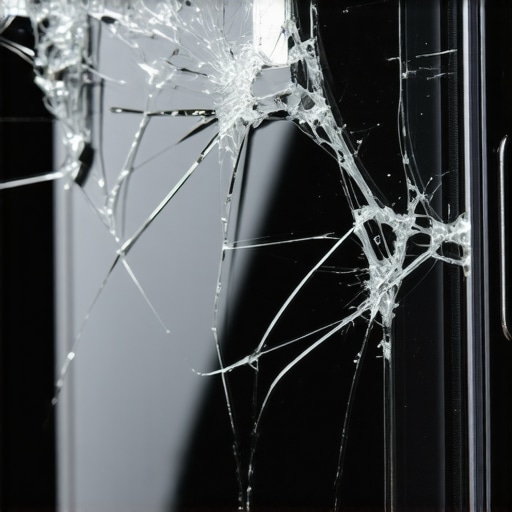
To understand why a screen protector is useless against a corner chip, we have to look at how glass is tempered. In my shop, we see this constantly with glazing beads and sashes. Glass is heated to over 1,200 degrees Fahrenheit and then rapidly cooled, a process called quenching. This creates a outer ‘skin’ that is compressed at roughly 10,000 psi. The corner is the most vulnerable part of this ecosystem because it is where the stresses from three different planes converge. When a chip occurs at the corner, you have created a ‘stress riser.’ This is a point where the internal tension of the glass core is no longer contained by the compressive outer layer.
A glass installer knows that a chip is not just a cosmetic issue. In a mobile service context, we often see people who want a quick chip repair for a windshield or a side lite. If that chip is in the center, we might have a chance. But if it is near the edge, the rough opening of the frame or the shim pressure will eventually cause that chip to ‘run.’ A screen protector only provides surface-level tension. It does nothing to counteract the internal ‘pull’ of the glass molecules trying to return to a relaxed state. In a same-day service call, the only real solution is a full replacement because the safety of the unit is gone.
Thermal Dynamics and the SHGC Factor
In hot climates like Phoenix or Texas, the Solar Heat Gain Coefficient (SHGC) plays a massive role in glass failure. If you have a chipped corner and the sun hits that window, the glass begins to expand. However, it does not expand uniformly. The area with the chip is now a thermal bridge. The Low-E coating on Surface 2 (the inner face of the outer pane) is busy reflecting long-wave infrared radiation back outside, but the heat is still building up in the glass substrate itself. As the glass expands, the stress at the shattered corner increases exponentially. This is why a window might look fine in the morning but suddenly ‘spiderweb’ across the entire surface by 3 PM. No screen protector can hold back the force of thermal expansion.
“The edge seal and frame interface are the primary failure points for thermal performance and structural integrity in modern fenestration.” NFRC Performance Standards
The Mobile Service Reality Check
When you call for mobile service, you are paying for the expertise of someone who understands how to manage the rough opening and the sill pan. A professional will look at the weep holes and the flashing tape to ensure that when the new glass is installed, it is not subjected to the same stresses that caused the first failure. If the original installer did not use the correct shims, the glass might be ‘binding’ against the frame. This creates a permanent pressure point. You can put ten screen protectors on that glass, but as long as the frame is putting pressure on that corner, it is a ticking time bomb.
We also have to consider the muntins and the operable parts of the window. If a window is opened and closed frequently, the vibrations travel through the frame and settle in the corners. A chip in the corner of an operable sash is significantly more dangerous than one in a fixed picture window. Every time you slam that window or even just latch it, you are sending a shockwave directly into the weakened glass lattice. A screen protector is essentially a cosmetic fix for a mechanical disaster.
Why Professional Chip Repair is Different
True chip repair involves injecting a specialized resin that has the same refractive index as the glass. More importantly, it has the same thermal expansion coefficient. The resin is cured using UV light, effectively ‘welding’ the crack back together. A screen protector just sits on top. It does not penetrate the fracture. It does not stabilize the tension core. It just hides the problem until the day the entire pane decides to give up. As a glazier, I refuse to perform ‘patch jobs’ on corner chips because I know that my reputation is only as good as the glass I leave behind. If I cannot guarantee the safety of the sash, I will not sign off on the job.