Why your Face ID stops working after a screen drop
I have spent over 25 years as a master glazier, handling everything from curtain walls in skyscrapers to the most delicate architectural glass. When people ask me why their Face ID stops working after a minor screen drop, they expect a software answer. They are wrong. It is a glass and structural engineering failure. As a glass installer, I see the same patterns of failure in a smartphone that I see in a poorly flashed window unit in a Chicago winter. Glass is a rigid, unforgiving substrate, and when its structural integrity is compromised, the high-precision optics behind it become useless.
The Installation Autopsy: A Tale of Hidden Rot
I pulled a shattered screen assembly out of a high-end device last week in my mobile service unit, and the internal sensor housing was already showing signs of oxidation. Why? The previous technician had performed a same-day repair but relied on a cheap adhesive strip instead of a factory-grade gasket. It reminded me of a time I pulled a vinyl window out of a house in Toronto and the header was completely black with rot. The previous installer relied on the nailing fin instead of proper flashing tape. In both cases, the ‘caulk-and-walk’ mentality led to a catastrophic failure of the internal environment. When your screen drops, you aren’t just breaking glass; you are breaching the rough opening of a sophisticated optical system.
“Installation is just as critical as the window performance itself. A high-performance window installed poorly will fail.” – AAMA Installation Masters Guide
The Physics of the Rough Opening and Optical Interference
In the glazing trade, we talk about the rough opening—the space into which a window is set. In your smartphone, the Face ID assembly sits in its own rough opening behind the glass. This assembly relies on a Dot Projector, a Flood Illuminator, and an Infrared Camera. These components require a perfectly clear, undistorted ‘glazing’ to function. When the glass is chipped or cracked, it introduces a series of unintended prisms. Even a tiny chip repair that looks fine to the eye can cause a massive shift in the refractive index.
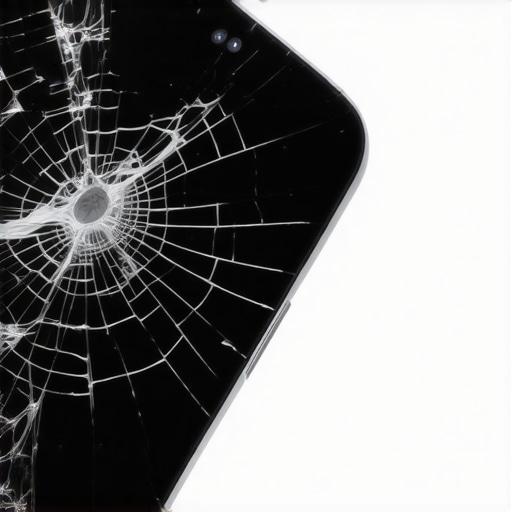
Glazing zooming into the physics: Face ID projects 30,000 infrared dots. These dots must pass through the glass substrate and return to the sensor. If the glass has suffered a structural failure, the light hits the fracture and undergoes total internal reflection or diffusion. The infrared light, which has a longer wavelength than visible light, is particularly sensitive to the microscopic imperfections in the glass. This is why your Face ID says ‘Move iPhone lower’ or ‘Face ID is unavailable.’ The sensors are essentially looking through a frosted window.
Thermal Ingress and the Dew Point Crisis
In cold climates like Minneapolis or Chicago, the enemy of glass is the dew point. When you drop your phone and create a hairline fracture, you have effectively eliminated the thermal break. The interior of your phone is warm; the air outside is freezing. Moisture-laden air is drawn through the crack via capillary action. Once inside the ‘sash’ of the screen assembly, this moisture condenses directly onto the TrueDepth camera lens. I have seen this a thousand times in residential windows where a failed seal leads to fogging between the panes. In a phone, that fogging happens on a nanometer scale, blinding the sensors.
“ASTM E2112-19e1 emphasizes that the fenestration system must maintain a continuous seal to prevent the ingress of deleterious substances.” – ASTM Standard Practice for Installation of Exterior Windows
This is why a simple glass installer for mobile devices cannot just slap a new piece of glass on. They must ensure the glazing bead—the adhesive seal—is airtight. If the seal is compromised, the first time you walk from a heated car into a snowy parking lot, the internal humidity will reach its dew point, and your Face ID will fail. This isn’t a software bug; it’s a failure of the flashing system.
The Material Science of the Substrate
We don’t use soda-lime glass for high-performance applications, and neither does your phone. It uses aluminosilicate glass, which undergoes a potassium-ion exchange process to create deep compression layers. This is similar to tempered safety glass but on a much more intense scale. When this glass drops, the tension is released. Even if the glass doesn’t shatter, the internal stress can warp the frame or the ‘shim’ layers that keep the sensors aligned. A mobile service professional must check the frame for squareness, just as I would check a window frame before installing a new sash. If the frame is bent by even a fraction of a millimeter, the sensors will be out of alignment with the muntins of the infrared grid.
[image_placeholder_1]
When considering a chip repair or a full replacement, remember that the glass is the first line of defense for a system that is more precise than any laser level I use on a job site. A same-day repair is convenient, but it must respect the ‘shingle principle’ of water and dust management. If the technician doesn’t clean the rough opening or replace the internal flashing tape, you are just waiting for the next ‘rot’ to set in. Do not let a ‘Tin Man’ style salesman tell you that any glass will do. The U-factor of the glass might not matter here, but the visible transmittance and the absence of optical distortion are everything. If the glass is not perfectly flat, or if the adhesive creates a ‘weep hole’ where there shouldn’t be one, the device will eventually succumb to environmental stress.
Final Verdict: The Installer Matters More Than the Sticker
At the end of the day, a window—or a phone screen—is only as good as its installation. You can buy the most expensive triple-pane unit in the world, but if the installer doesn’t understand sill pans and drip caps, your walls will rot. Similarly, you can buy a premium replacement screen, but if the mobile service tech doesn’t understand the seal of the TrueDepth chamber, your Face ID is a goner. Trust the trade craft. Demand precision. Glass is not a DIY project when your identity is the key.
{“@context”:”https://schema.org”,”@type”:”HowTo”,”name”:”Assessing Face ID Failure After a Screen Drop”,”step”:[{“@type”:”HowStep”,”text”:”Inspect the glass for hairline fractures directly over the sensor notch using a magnifying glass.”},{“@type”:”HowStep”,”text”:”Check for internal condensation or ‘fogging’ behind the glass substrate.”},{“@type”:”HowStep”,”text”:”Verify if the screen assembly is seated flush within the frame, ensuring no gaps in the glazing bead.”},{“@type”:”HowStep”,”text”:”Test the sensor in a controlled temperature environment to rule out dew point issues.”}]}