How a mobile glass installer handles extreme heat on the job
The Reality of Solar Loading and Mobile Glass Service
Working as a glass installer for over two decades has taught me that the sun is either your best friend or your most formidable enemy. When you are performing a mobile service in the peak of summer, the glass surface temperature can easily exceed 150 degrees Fahrenheit. This is not just a matter of technician comfort; it is a matter of molecular physics. If you do not understand how extreme heat affects the structural integrity of a sash or the curing rate of a chip repair resin, you are going to have a failure in the field. I have seen countless ‘tailgate’ installers ruin a windshield or a residential pane because they did not account for thermal shock. When you apply a cool repair resin to a sun-baked surface, the sudden temperature differential can turn a small bullseye chip into a massive crack that spans the entire width of the glass in seconds.
The Condensation Crisis in High-Heat Zones
A homeowner in the desert once called me in a panic because their brand-new high-performance windows were ‘sweating’ on the exterior every morning. They were convinced the seals had failed on all twenty units. I arrived with my hygrometer and a thermal imaging camera to show them the reality. The interior of the house was kept at a frigid 68 degrees while the outside humidity was uncharacteristically high. The windows were performing exactly as they should; they were so thermally efficient that the exterior pane remained at the outdoor dew point temperature. It was a lifestyle and HVAC balance issue, not a product failure. This is the level of education a true glazier provides. We don’t just swap parts; we manage the building envelope. In high-heat climates, we are fighting a constant battle against Solar Heat Gain Coefficient (SHGC). We look for a low SHGC, typically under 0.25, to ensure that the glass is reflecting the infrared spectrum rather than absorbing it and radiating that heat into the living space.
“Installation is just as critical as the window performance itself. A high-performance window installed poorly will fail.” AAMA Installation Masters Guide
The Science of Surface #2 and Low-E Coatings
When we talk about heat, we must talk about surface chemistry. In a standard double-pane insulated glass unit (IGU), there are four surfaces. Surface #1 is the exterior, #2 is the inside of the outer pane, #3 is the outside of the inner pane, and #4 is the room-side surface. For a mobile glass installer working in extreme heat, we prioritize the Low-E coating on Surface #2. This positioning reflects the solar radiation before it even crosses the argon-filled gap. If the coating is on Surface #3, the heat has already entered the unit, which increases the thermal stress on the glass and the spacers. We use warm-edge spacers, often made of structural foam or thermoplastic, because they handle the expansion and contraction of the glass far better than old-fashioned aluminum spacers. Aluminum has a high rate of thermal conductivity, which creates a ‘thermal bridge’ at the edge of the glass, often leading to condensation or seal failure when the mercury rises.
Same-Day Chip Repair: The Mobile Challenge
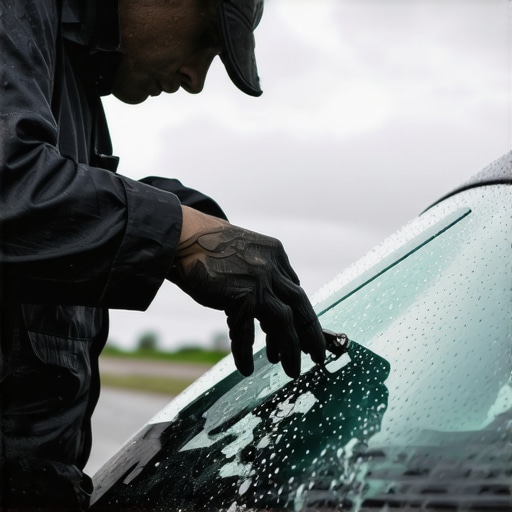
Providing same-day chip repair in 100-degree weather requires a specific protocol. First, the technician must stabilize the glass. We use portable UV shades to drop the surface temperature before we ever touch the glass with a bridge or injector. If you attempt a chip repair on hot glass, the resin viscosity drops too low, and it won’t hold the vacuum necessary to pull the air out of the break. Furthermore, the expansion of the glass molecules actually ‘squeezes’ the break shut, preventing the resin from penetrating the microscopic fissures. We often use a localized cooling method, but we never use cold water or ice, which would cause an immediate fracture. We rely on air movement and shade to reach the ‘sweet spot’ for resin bonding. This is why a mobile service isn’t just about convenience; it is about having a controlled environment on wheels.
“The window glass is the most significant source of heat gain in a building. Proper selection and installation of glazing systems are vital to energy efficiency and occupant comfort.” NFRC Performance Guidelines
Managing the Rough Opening and Thermal Expansion
Whether it is an automotive glass replacement or a residential window, the frame must account for movement. A vinyl frame can expand significantly in direct sunlight. If the rough opening is too tight and the installer did not leave the proper shim space, the frame will bow, and the operable sash will bind. We use high-quality flashing tape and sill pans to ensure that even if the expansion causes a temporary gap in the primary sealant, the water management system remains intact. The ‘weep hole’ in the frame must be clear of debris to allow the internal pressure to equalize. Without this, the heat can cause the air inside the IGU to expand so much that it creates a ‘pillow’ effect, distorting reflections and potentially blowing the seal. A master glazier understands that glass is a dynamic material; it is constantly moving, expanding, and reacting to the sun’s energy.
Conclusion: Precision Over Speed
In the world of glass, speed is often the enemy of quality. Same-day service is a great marketing tool, but it must be backed by the technical discipline to handle environmental extremes. When you hire a glass installer, you are paying for their ability to read the NFRC label and understand how the U-factor and SHGC will interact with your specific orientation to the sun. Don’t be swayed by high-pressure sales tactics about gas fills that promise impossible ROI. Focus on the installation technique, the quality of the glazing bead, and the thermal break of the frame. In the end, it is the numbers on the spec sheet and the skill of the hands on the job that determine if your windows will last thirty years or fail in three. Always check the shims, verify the sill pan installation, and ensure your installer isn’t just a ‘caulk-and-walk’ amateur. Precision is the only thing that stands between a comfortable home and a costly replacement cycle.