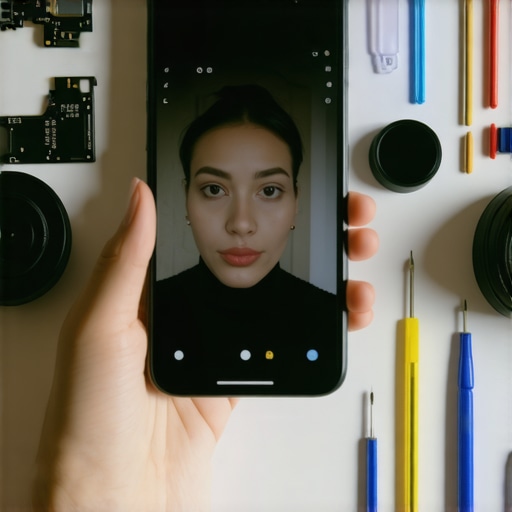
Fixing the blurry mess on your selfie camera
The Micro-Glazing Challenge: Why Your Optics Failed
As a master glazier with a quarter-century in the trade, I have seen every type of glass failure imaginable. From the structural collapse of a multi-story curtain wall to the subtle seal failure in a residential casement, the physics remains constant. When people complain about a blurry selfie camera, they usually think it is a software glitch or a dirty thumbprint. In reality, you are dealing with a microscopic glazing installation that has likely suffered a breach in its environmental seal or a degradation of its surface coatings. To a glass installer, a smartphone is simply a miniature sash assembly, and the same rules of moisture management and light transmission apply.
A mobile service professional looks at your device and sees a rough opening that must be perfectly sealed against the elements. If that seal fails, you do not just get a bit of dust; you get a localized atmospheric disaster. I remember a specific case that illustrates this perfectly. A homeowner called me in a panic because their new windows were ‘sweating.’ I walked in with my hygrometer and showed them the humidity was 60%. It wasn’t the windows; it was their lifestyle. The same thing happens with your mobile glass. You take that device from a cool, air-conditioned room into the humid air of a Southern summer, and if your gaskets are compromised, the dew point is reached inside the lens assembly. That blurriness is internal condensation, a micro-version of a failed insulated glass unit (IGU).
“Installation is just as critical as the window performance itself. A high-performance window installed poorly will fail.” – AAMA Installation Masters Guide
The Physics of the Blur: Surface #1 vs. Surface #2
In the world of architectural glazing, we talk about glass surfaces by number. Surface #1 faces the exterior, while Surface #4 (in a double-pane unit) faces the interior. Your camera lens is no different. Most ‘blurry’ issues are a result of the degradation of the oleophobic coating on Surface #1. This coating is designed to repel oils, but as it wears down, skin oils begin to fill the microscopic valleys in the glass. This changes the refractive index of the surface. Instead of light passing through the glass and hitting the sensor at the intended angle, it scatters. This is called diffraction, and it is the enemy of any glass installer striving for clarity.
When you seek a same-day chip repair or mobile service for your glass, you are essentially asking for a restoration of these optical properties. In high-heat climates like Texas or Florida, the solar heat gain (SHGC) is not just a problem for your living room; it is a problem for the adhesives holding your camera’s glazing bead in place. High temperatures can cause the adhesives to outgas, leaving a cloudy residue on the interior of the glass. This is why we insist on thermally stable components. If the SHGC is too high, the internal temperature of the device can exceed the boiling point of certain volatile organic compounds used in the assembly, leading to permanent internal fogging.
Mobile Service and the Art of Chip Repair
If your lens blur is actually caused by a physical chip or scratch, the fix requires a technical understanding of resin injection. We use a similar logic when repairing a windshield or a high-end storefront. The goal of a chip repair is to displace the air trapped in the fracture with a clear resin that matches the refractive index of the glass. This requires a clean environment and precise pressure. A mobile service technician must manage the ambient temperature to ensure the resin cures without shrinking. If the resin shrinks, it pulls away from the edges of the chip, creating a ‘halo’ effect that is just as bad as the original blur.
We use the ‘Shingle Principle’ even in these small repairs. Water and dust must always be directed away from the sensitive internal components. When a glass installer replaces a screen or a lens cover, they must ensure the new part is properly seated in the frame, much like shimming a window to ensure it is level and plumb. If the lens is tilted by even a fraction of a millimeter (a micro-shim error), the focal plane is thrown off, and the ‘blurry mess’ persists despite the glass being clean.
“The window assembly must be designed to manage water penetration through the use of flashing, weep holes, and proper sealant application.” – ASTM E2112 Standard Practice
The Climate Logic of Glass Clarity
For those of us working in hot, southern climates, we must prioritize blocking the sun’s radiant heat. In a window, we would place a Low-E coating on Surface #2 to reflect that infrared energy back outside. In a mobile device, the glass installer must be aware of how heat affects the internal seals. If you are in a high-humidity coastal area, the risk of ‘weep hole’ failure is real. Yes, even devices have tiny vents that allow for pressure equalization. If these become clogged with lint or salt spray, the pressure differential between the inside and outside of the glass can suck moisture in during a rainstorm.
The solution is not just a quick wipe. It is a full autopsy of the installation. Is the sash (the screen assembly) properly bonded? Is the glazing bead intact? Are there micro-fractures allowing for capillary action to draw moisture behind the lens? A professional glass installer providing same-day service will look for these structural failures rather than just cleaning the surface. We look for the ‘rough opening’ tolerances of the camera housing to ensure no lateral pressure is being applied to the glass, which could cause birefringence—a phenomenon where the glass itself becomes a polarizing filter due to stress, further blurring your images.
The Myth of the Quick Fix
Do not trust ‘caulk-and-walk’ installers who claim a bit of toothpaste or polish will fix a blurry camera. Polishing glass is a dangerous game. If you remove too much material, you create a ‘lensing’ effect where the glass is no longer flat, distorting the light. This is why, in professional glazing, we rarely polish out deep scratches; we replace the unit. A same-day mobile service should focus on component replacement using factory-spec glass that maintains the original U-Factor and VT (Visible Transmittance) ratings. You want as much light as possible to reach that sensor, and any ‘repair’ that adds layers of cheap resin or plastic is going to degrade your image quality.
In conclusion, treating your camera lens like a high-performance window is the only way to ensure long-term clarity. Manage the heat, respect the seals, and understand that glass is a living material that reacts to its environment. When the blur won’t go away, it is time to call in a specialist who understands the difference between a simple smudge and a total glazing system failure. Focus on the numbers—the refractive index, the SHGC, and the structural integrity of the frame. That is how you fix the mess for good.