Why your windshield wipers should stay up after a repair
The Structural Integrity of Your Glass Aperture
Most vehicle owners view their windshield as a simple transparent barrier against wind and insects, but as a Master Glazier with over a quarter-century in the trade, I see it differently. The windshield is a structural member of the vehicle’s envelope, contributing up to 60 percent of the roof’s strength during a rollover. When you hire a mobile service for a chip repair or a full replacement, you are not just buying a piece of glass; you are commissioning a high-stakes chemical installation. The reason your glass installer insists on leaving your windshield wipers up after the job has nothing to do with tradition and everything to do with the physics of the bond.
A homeowner called me in a panic because their new windows were sweating and the sealant appeared to be weeping. I walked in with my hygrometer and showed them the humidity was 60 percent while they were running a humidifier in the dead of winter. It was not the windows; it was their lifestyle choices affecting the dew point. I see the same thing in automotive glass. People ignore the environment and then wonder why their same-day repair fails. The ambient humidity and temperature dictate the rate of molecular cross-linking in the polyurethane adhesive. If that bond is disturbed by the constant spring-loaded pressure of a wiper arm before it reaches its green strength, you risk a failure in the structural seal. This is the difference between a master and a caulk-and-walk technician who just wants to get to the next zip code.
“Installation is just as critical as the window performance itself. A high-performance window installed poorly will fail.” AAMA Installation Masters Guide
The Anatomy of the Rough Opening and the Pinchweld
In the world of architectural glazing, we talk about the Rough Opening and the Sill Pan. In your vehicle, the pinchweld is that rough opening. It is the metal flange where the glass must sit perfectly centered. We use a Shim, or a setting block, to ensure that the Sash of the glass does not migrate downward under the force of gravity. When a glass installer performs a mobile service, they are fighting against the elements. If the temperature is too low, the U-Factor of the glass becomes a liability. Heat loss from the cabin can cause the inner surface of the glass to stay warm while the exterior is freezing, creating a thermal stress that can crack a fresh chip repair if the resin hasn’t properly cured.
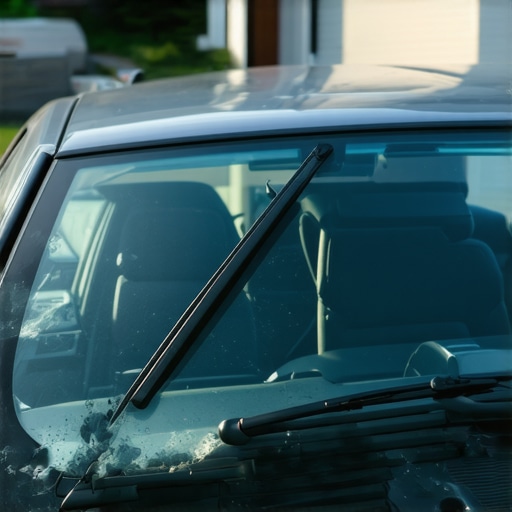
The Sill Pan of your vehicle is the cowl area. This is where Weep Holes are located to ensure that water which hits the glass and runs behind the trim does not enter the cabin. If an installer ignores the shingle principle and blocks these drainage paths with excess adhesive, you will end up with water on your floorboards and mold in your carpets. The wipers stay up because the spring tension in the arm can exert several pounds of localized pressure. On a fresh bead of high-viscosity urethane, that pressure can cause a thin spot in the seal. A thin spot is a future leak, a source of wind noise, or a point of structural failure during an airbag deployment.
The Physics of UV Curing and Resin Stability
For a chip repair, the science is even more granular. We are injecting a clear, refractive-matched resin into a break in the glass. This resin is usually anaerobic or UV-activated. If you put the wipers down immediately, the rubber blade can create a shadow over the repair site, preventing the UV light from reaching the resin at the correct angle. Furthermore, the Glazing Bead or the molding surrounding the glass needs time to settle without being compressed. We often see DIY attempts or low-quality mobile services where the Muntin or the decorative trim is misaligned because they didn’t respect the cure time.
“The integrity of the building envelope, or in this case the vehicle envelope, depends entirely on the continuity of the water and air barrier.” ASTM E2112 Standard Practice
In colder northern climates, we deal with the enemy of heat loss and condensation. The U-Factor of the glass is king. If the glass is not seated properly in its Rough Opening, you create a thermal bridge that leads to interior frosting. When we talk about operable windows in a house, we worry about the weatherstripping. In a vehicle, the windshield is a fixed Sash, but it must withstand incredible positive and negative wind pressures at highway speeds. A same-day service is a marvel of modern chemistry, but it does not bypass the laws of physics. The wipers remain in the service position to ensure that the chemical bond remains undisturbed during its most vulnerable phase.
Why Your Installer Matters More Than the Brand
I have seen thousand-dollar pieces of impact-rated glass fail because the installer didn’t use Flashing Tape correctly or forgot the primer on the pinchweld. In the automotive realm, if the technician doesn’t clean the glass with a proper activator, the same-day service becomes a lifetime of regret. The adhesive needs to bond to the frit, the black ceramic dots around the edge of your glass, which protects the glue from photodegradation. If you lower those wipers too early, you might even smear the primer or the activator, leading to a cloudy residue that is nearly impossible to remove without damaging the Glazing Bead.
The math of energy savings in a home is much like the math of safety in a car. You focus on the numbers that matter: U-Factor, SHGC, and the tensile strength of the bond. Do not be seduced by the high-pressure salesman who tells you the car is ready the moment the glass is in. Respect the cure. Respect the glass installer who tells you to leave those wipers up. They are protecting the structural integrity of your vehicle and ensuring that the hole in your car’s wall is managed for water, air, and safety. A window is only as good as its seal, and a seal is only as good as the technician who understands the science behind it.