Why your phone speaker sounds muffled after a repair
The Acoustic Failure of Improper Sealing
As a Master Glazier with a quarter-century in the trade, I look at a smartphone screen differently than most. To me, that glass is a microscopic curtain wall. It is a precision-engineered transparent assembly that must maintain a pressurized environment while managing sound waves and moisture. When a homeowner or a tech-user complains that their audio sounds like it is underwater after a glass replacement, I do not see a software bug. I see a seal failure. In the world of high-performance fenestration, we call this an acoustic bridge. It is the same reason a high-end triple-pane window can sound like a screen door if the glazing bead is not seated correctly or if the installer forgot to shim the frame to dead-center. The physics of sound do not change just because the glass is smaller. Whether you are dealing with a 100-story skyscraper or a device in your pocket, the integrity of the barrier is the only thing standing between performance and failure.
A homeowner called me in a panic because their new windows were ‘sweating.’ I walked in with my hygrometer and showed them the humidity was 60%. It wasn’t the windows; it was their lifestyle. They were boiling pasta and running the shower without ventilation, and those high-performance seals were doing their job too well, trapping moisture inside a previously drafty house. This same principle applies to mobile glass installer services. If a technician performs a chip repair or a full glass replacement in a high-humidity environment without controlling the dew point, they are sealing failure directly into the assembly. When that speaker sounds muffled, you are often hearing the result of adhesive ‘squeeze-out’ or trapped moisture vibrating against the diaphragm. It is the ‘caulk-and-walk’ mentality migrated from the construction site to the repair bench.
“Installation is just as critical as the window performance itself. A high-performance window installed poorly will fail.” – AAMA Installation Masters Guide
The Physics of Sound Transmission Class (STC)
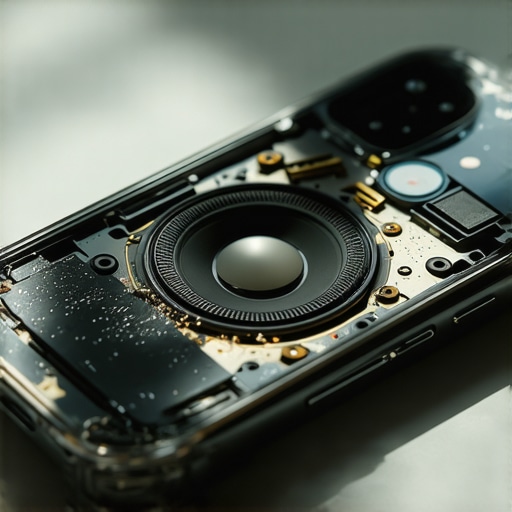
In the glass industry, we measure sound control using STC (Sound Transmission Class). A standard single-pane window has an STC of around 26 to 28. A high-performance acoustic assembly with laminated glass can reach 40 or higher. When a repair technician uses an inferior glass substrate or a generic adhesive, they are effectively lowering the STC of your device. Sound is a longitudinal wave that requires a medium to travel through. In a perfectly sealed unit, the sound from your speaker travels through the port and reaches your ear. However, if the glass installer used a high-viscosity resin that bled into the acoustic chamber, those sound waves are now trying to move through a solid or semi-solid mass. This is why the audio sounds muddy. The resin acts as an unintended dampener, absorbing the high-frequency vibrations that provide clarity in speech and music.
Furthermore, we must consider the OITC (Outdoor-Indoor Transmission Class), which specifically focuses on lower frequency sounds. In coastal environments where wind pressure is a constant factor, the seal must be absolute to prevent ‘whistling.’ If your mobile service technician did not use a vacuum-seal during the same-day repair, air gaps remain. These gaps are not just for water; they are channels for sound. A gap as small as 1/16th of an inch can reduce the acoustic performance of a glass barrier by 50 percent. This is why I always emphasize the Rough Opening tolerances in window installation; if the frame is not square, the sash cannot seal. In your device, if the glass is not perfectly centered within its chassis, the gaskets cannot compress, leading to that hollow, muffled sound.
Moisture Ingress and the Coastal Conflict
In regions like Florida or the Carolinas, the humidity is a constant enemy of glass installations. We treat every window as a sacrificial barrier against positive and negative wind pressures. When you get a same-day chip repair or glass replacement in these climates, the risk of ‘fogging’ or muffled audio increases exponentially. This is because moisture is often trapped during the curing process. In the glazing trade, we use dessicant-filled spacers to absorb this internal moisture. Your phone does not have that luxury. If the glass installer fails to use a neutral-cure silicone or a high-grade polyurethane seal, the moisture in the air is locked inside. Over time, this moisture reacts with the speaker’s delicate metallic components, leading to corrosion and, you guessed it, muffled audio.
“The primary goal of any glass installation is to maintain the continuity of the building envelope’s water and air barriers.” – ASTM E2112 Standard Practice
We also have to discuss the ‘shingle principle.’ In window flashing, we always overlap materials so that water flows down and away from the Rough Opening. A mobile glass repair often ignores this logic. They apply a bead of adhesive and press the glass down. If the adhesive is too thin, it allows air to bypass the seal. If it is too thick, it overflows into the muntin-like spacers of the speaker assembly. This is not just a cosmetic issue. It is a fundamental violation of glazing science. A proper seal should be ‘thermally broken,’ meaning there is a physical separation that prevents temperature and sound from jumping across the gap. When a repair tech slops glue into that gap, they create a bridge that transmits unwanted vibration while muffling the intended sound output.
The Glazing Bead and Pressure Equalization
Why do we use weep holes in windows? To allow pressure equalization. If a window is sealed too tightly without a way for the internal cavity to breathe, the glass can actually bow or crack under thermal expansion. While your phone screen is smaller, the glass and the frame still expand and contract at different rates. If a chip repair is done with a resin that is too rigid, it will not move with the glass. This creates internal stress. In the window world, we use shims to ensure that the glass sits perfectly in the opening without touching the frame. This ‘floating’ state is what allows for longevity. If your repair technician ‘hard-set’ the glass without proper spacers or shims, the pressure on the speaker assembly is uneven. This pressure can physically deform the speaker housing, leading to a permanent muffle that no software update can fix.
When you seek a mobile service for glass, you must ask about the curing time and the type of sealant used. A ‘same-day’ fix is often a ‘now-problem’ later. In high-rise glazing, we let seals cure for days before subjecting them to wind loads. When you turn on your speaker immediately after a repair, the acoustic vibrations are hitting a wet seal. This can cause ‘micro-bubbles’ to form in the adhesive, which eventually harden into a honeycomb-like structure that ruins the sound quality. It is the same reason we never install a window during a rainstorm; you are just inviting failure into the wall.
The Verdict on Professional Glass Installation
Ultimately, the quality of a glass repair comes down to the technician’s understanding of the materials. A real glass installer understands that glass is not static; it is a dynamic material that reacts to heat, sound, and pressure. Whether it is a Sill Pan in a residential home or a gasket in a mobile device, the goal is the same: absolute control over the environment. If your speaker is muffled, you are looking at a failure of the ‘glazing bead’ equivalent in your device. It is a sign that the installer prioritized speed over the physics of the seal. Don’t buy the hype of a quick fix if it ignores the fundamental laws of fenestration and acoustics. Demand a repair that respects the science of the glass.
“”